When watching starry sky at the
night, numerous twinkling stars and that enormity, what the heavenly
cover offers for everyone to see, one surely convince himself how small
people are compared to the huge or probably infinite size of the
universe. But, althouhg the universe is enormous big space, is the
universe or cosmos really infinite? And what means that universe would
be infinite? And, on the other hand, what means if universe would be
finite?
As a good starting point many of us probably assume that if we had a
spaceship, which is able to travel in space forever and is also able to
keep its direction so that it would fly straight line though the space,
the
spaceship would be able to move forever in some direction (of course we
need to suppose, that it won't crash with some planet or something).
People who think this way may also think, that the space must be infinite, because if it's
not infinite, the spaceship cannot move forever in some direction but
the travel will be prevented one way or another. But this is not
necessarily the
case: The alternative to the infinite space need not to be limited
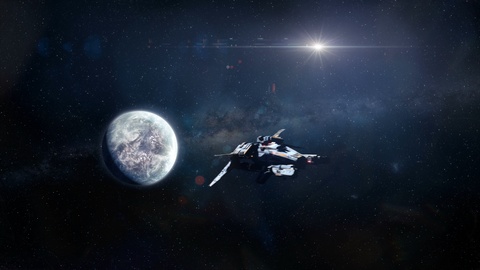
(notice I said limited, not finite) like the video game fields
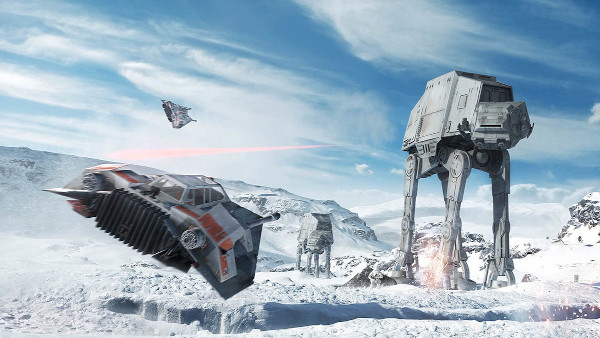
are, for example in figure 1.
Figure 1. A view from Star Wars Battlefront II video
game.
Finite space need not to be aviary or
aquarium, but the universe can be both unlimited and finite (someone
would say borderless or without boundaries or without edges instead of unlimited, but let's use words
unlimited / limited in this text). If the space is finite, a spaceship
moving
forever straight in some direction will eventually arrive to its
starting point
just like an aircraft flying straight around the Earth. Consequently, a
single
choice between infinite and finite is not enough to define the
universe, but the universe also needs to be unlimited or limited. These
two choices are the foundation to solve the structure of the universe
as I will demonstrate in this text. If mankind wants to know, where
they are living and what they are, mankind needs to know right ansvers
to these two choices.
But what is a straight line? Question is important, because the
spaceship needs to travel along a straight line to find out whether the
space is infinite or finite. In a real life, straight line is a rope
hanging with a weight. In mathematics a staight line is defined as a
shortest possible route between two points. In physics it is usually
defined - although not always, at least not in optics nor relativity
theory - that light moves through a straight line. But light itself is
defined in physics so that it will always travel a voyage between two
points through a shortest possible route. A spaceship probably keeps
its direction like light, but the shortest possible route is not
necessarily a straight line! In order to keep the shortest possible
route and the straight line equal in space, the material in space needs
to be equally spread everywhere, i.e. instead of planets, stars and
galaxies, there should be only gas. Let's suppose hypotethically that
space contains only equally spread gas so our space ship can really
travel straight line without crashing anything.
These two choices, infinite / finite and unlimited / limited, give four
choices as the basis of the structure of the universe. Part of them can
easily be treated as impossible choices, but not all of them. Let's
introduce ourselves with each of the four alternatives:
Limited and Finite Universe
Someone would call this fringe and finite universe. This
alternative means that the universe and therefore also space (I'll
explain the difference later in this text) would be like a closed room.
Nothing is able to penetrate those walls which encloses the universe;
the borders of space are restrictive and imprisoning same way than are
the fields of today's popular video games. Space would be like an
aviary or aquarium, which has some shape, volume and lifetime. I bet
this kind of model of the universe would be unrealistic and repulsive
by many of the readers. But most importantly, none of the scientific
observations or any physical theory would suggest this kind of space or
universe existing.
To find limited and finite
universe cannot be true we could consider light and First Law of
Thermodynamics (First Law of Thermodynamics is a physical theory ie.
human invention. It was invented by James
Prescott Joule in 1843 A.D. It is not an observation, but it is
proved to be true on Earth by many observations. Of course, nothing
proves it is true everywhere
in the space, but let's hope this is the case.) The First Law of
Thermodynamics states that energy can change from one form to another,
for example heat energy to kinetic energy, but its total amount doesn't
change. And light is electromagnetic radiation, a form of energy, which
travels along as photons. In order to fulfill the First Law of
Thermodynamics in the universe, photons need to stay inside the
universe. If universe would be limited
and finite its' borders should have mirrors which reflects
photons back into universe. If this would be the case, the light coming
from numerous stars in the space would reflect endless times from those
mirrors and we couldn't get any sensible view from the starry sky
visible in the night.
Another, more obvious argument against limited and finite universe is the
gravity moving dust, moons, planets, stars and galaxies, all the
celestial bodies in the space. Gravity is the force which steers the
Earth to revolve around the Sun, keeps the Earth as a solid planet and
also keeps you staying on the surface of Earth instead of you to float
into space. This gravity won't stop celestial bodies to fly against the
mirror on the border of the universe and break that mirror. Then, what
would stop photons to escape from universe when even celestial bodies
or our spaceship
exit from there?
Limited and Infinite Universe
Previous alternative would certainly be problematic as a universe,
because the contents of the universe must remain inside the universe.
The universe is everything which exists. No part of the universe, even
as tiny as a photon, cannot exit from universe, and outside of the
universe is nothing, which could enter into universe. If either of
those would happen, that would mean the universe is bigger than we
thought: everything we thought the universe contains, that would be
only a part of the universe.
One way to solve how to keep the contents inside and include everything
imaginable into the universe is to state, that the universe is infinite.
When the universe is infinite also space would be infinite, and that
makes enclosing space inside mirrors impossible, because an infinite
space cannot fit into any container! If space is infinite, our
spaceship could travel forever into the same direction without ever
returning back to the starting point. However, this kind of universe
would still be limited,
because the four dimensions of space, namely three spatial dimensions
and one time dimension, don't have any interconnection with each
other. For example, dimensions of space could have interconnection with
each other by being curved in a way, which makes our straight line
travelling spaceship to return back to starting point somewhere in the
future, in which case universe would be unlimited.
Limited and infinite universe model is the basis of the worldview
of current cosmology and international scientific community. Someone
might point out that this statement is not true, because our
understanding of the universe is based on expanding universe model introduced
by Aleksandr Friedmann in
1922 A.D. Expanding universe models are characterized by an idea the
universe has started by a Big Bang:
there are four Friedmann models (today we probably have even more
models, but except my own model, I don't know any model of the
universe, which does not include Big Bang) and all those suggest the
universe has born in a Big Bang abot 14 billion years ago. The original
model of Friemann suggest that the universe has born in a Big Bang,
then it expands to some finite size and finally starts to shrink in the
future. Three other models also suggest the universe has born in a Big
Bang, but they will expand indefinitely, bigger and bigger.
I need to admit that the original Friedmann model is finite, but all Big Bang models are
limited,
because only three spatial dimensions have interconnection with each
other and time dimension does not. Unlimited universe is not possible,
if any of those dimensions is not 'closed'. All Friedmann models have
four dimensional universe: they have three spatial dimensions, let's
say length, width and height and fourth separate
dimension time, which
represents the radius of the four dimensional sphere.
Our space ship or celestial bodies as well as light stay inside
Friedmann universe by moving on the surface of four dimensional sphere.
This is an analog to ordinary three dimensional sphere, like the Earth
or a football: the surface of the sphere is two dimensional, closed
surface, but bespite of its two dimensionality the surface can exist
only in a three dimensional space. We all know that the map of a globe
can be drawn only on a sphere, not on a paper sheet, if we don't accept
distortions. The three dimensional geometry, the space we are living,
can exist only in a four dimensional geometry in order to have an
interconnection between three dimensions.
Furthermore, Friedmann models must be limited
for a reason the Big Bang is an absolute limit or boundary in those
models. While in the original Friedmann model it would be possible that
spaceship travels a straight line and returns back to the starting
point, there are not enough time to do that before the universe
collapses (according to Stephen W.
Hawking the spaceship needs to travel faster than the speed of
light, which is impossible). The other three Friedmann models don't
collapse, because instead of shrinking in the future they will expand
indefinitely and their materia will become more and more rare: in this
case a straight traveling spaceship would newer return back to the
starting point because expanding space makes its journey ever longer.
Scientist have found that limited
and infinite universe model
would be comfortable for them, because if the universe is infinite,
they don't need to determine beforehand, what ever the universe may
contain and what not: when we get new, unexpected observations about
the universe, we can just conclude that infinite universe can contain
everything! And we don't need to change the model of the universe to
respect new observations – for example, that the universe would be
finite. Instead, we just add complexity into the old model. Now, when
scientist have so good telescopes that they can recognise galaxies
further away than 14 billion light years, which is beyond the Big Bang
boundary, they have a real challenge to explain it...
Unlimited and Finite Universe
Another way to ensure nothing can escape outside the universe is
the finite universe, but to
get this working the universe also needs to be unlimited. Previously mentioned
original Friedmann universe model is commonly considered as finite and
borderless, but I classified it into the alternative limited and infinite. Obviously any Friedmann
model cannot be unlimited and
finite.
In this text I will show that the unlimited and finite universe has six
dimensions (actually it has seven dimensions, but only six dimensions
have practical usage). The mass of the universe is equally spread
across the space (of course not perfectly equally, there are celestial
bodies in empty space, galaxies etc, but big picture is equally spread
materia everywhere in space). Unlimited and finite universe is not born
in the Big Bang – there is no such a thing like Big Bang. It doesn't
collapse or expand indefinitely. It is perpetual motion machine
forever. The dimensions of space have an interconnection so that each
dimension affect to each other: this is precisely what is meant by the unlimited in this text. The
limitlessness of the universe combined with the finitude of the
universe makes possible the universe's ability to renew and transform.
Because of the interconnection of dimensions, our spaceship or
whatever, which travels all the time to the same direction, eventually
returs to its starting point (or would do that, if the universe would
allow enough time for that, but that is impossible). The return to the
starting point doesn't happen because of gravity, but the geometry of
space forces the spaceship to arrive to its starting point. And,
ironically, it is the gravity which creates the geometry to the space,
as defined in Einstein's general theory of relativity. The model of the
unlimited and finite universe
follows Einstein's Special and General
Relativity with certain exceptions.
Unlimited and Infinite Universe
There is one more alternative, namely that the universe is both
unlimited – dimensions have interconnection – and infinite – so our
spaceship traveling to the straight line never returns back. But this
is logically impossible: if dimensions have interconnection, then
straight line traveling spaceship is forced to return to the starting
point. The spaceship either returns back to starting point or then not,
but it cannot do both.
Anyways, someone may suggest, that dimensions having an interconnection
does not need to be a closed circle, but it appears somehow else.
However, the undersigend has no idea of any alternative theory for
connecting dimensions.
Does the Universe expand?
As already stated, the universe is expanding according to the
common understanding. All major structures i.e. galaxies and group of
galaxies, all matter is spreading out over an ever-widening area in the
space. However, condensation also occurs locally, for example in
regions inside galaxies, where dust is concentrating into new solar
systems, but the big picture is expansion. How has this expansion been
measured or how has this conclusion been reached?
The closest galaxy with our own galaxy Milky Way, is the Andromedas and
it is located about two million light years away. The light we see
coming from Andromedas galaxy today, has travelled two million years
here. It is quite clear that these distances haven't been measured by
any measuring tape, but it is also impossible to use any kind of radar:
at least theoretically be measured with radar, the radar signal needed
to be sent from the Earth to the Andromedas four million years ago so
that we could receive the echo signal in our lifetime. Even angle
measurement, familiar from land surveying, cannot be used to measure
astronomical distances. These distances can be maeasured only by
indirect methods and estimates given by them are only indicative.
Instead, we can measure (or we think
we can measure) with reasonable accuracy whether some distant
light-emitting object, like a star or galaxy, is approaching or
receding us: cosmologists talk about the redshift of stars based on the
Doppler effect, which is observed to be the bigger the further away the
star is from us. Cosmologists think the redshift is a proof of the
universe expanding, but I think that it is a proof that the universe
has more dimensions than the three spatial dimensions and time
dimension we can observe. The redshift was first observed by Edvin Powell Hubble in the 1920s
and since then the redshift has been the key observation we need to
take account in any attempt to model the universe. So far the general
consensus has been the redshift is caused by Doppler effect and that
everything is receding each other in the space, but I have an
alternative theory.
So redshift is all about that the spectrum of light coming from a
distant star has transformed towards the red end of the spectral scale
i.e. the wavelength of the light is longer than ecpected (red light is
the longest wavelenth human eye can see whereas blue light is the
shortest, therefore the name redshift).
The reader may want to ask how the scientist know what kind of light
some distant star or galaxy emit? Well, there's no way to know it, but
we know what kind of light our own Sun emits and we have an assumption
that other stars are similar than ours... The wavelenth elongation
could be explained by the Doppler effect i.e. the star is moving away
from observer, but I suggest that any electromagnetic radiation – all
kinds of photons, including light – very slowly loses its energy during
travel and that explains wavelength elongation. The problem we have
here is, that if the wavelength elongates so also the frequency lowers,
the light is losing the energy it carries. According to the first law
of thermodynamics, the energy can change its form, but the total amount
of energy cannot change, so where goes the energy the light is losing?
We could think, that the photons of light spontaneously decay, that
they would emit very small energy quanta as a function of time and
these energy quanta scatters as thermal radiation into space. However,
the theory of electromagnetic radiation does not know any spontaneous
decay of photons. Besides, if photons would spontaneously decay more
several photons and these still more, the only thing we could see in
the starry sky would be noise familiar with old tube televisions, and
that is
not the reality.
When the frequency of light lowers very slowly as a function of time,
the energy what photons loses does not stay in the space causing noise,
but it goes into those two additional dimensions in the universe: this
is my explanation for the redshift. This also defines the difference
between words universe and space in this text: the universe
contains all six (or rather seven) dimensions and the space or more
precisely time-space has only four dimensions we can observe, namely
width, length, height and time. Those two (actually three) additional
dimensions, that we cannot perceive, let's call them afterlife. If the universe includes
afterlife, there are no need
for an expanding universe model or the Big Bang theory and the lifetime
of the universe is not limited.
Why the light behaves so strangely?
There are also another observation than redshift which support an
idea, that the universe contains more dimensions we can perceive i.e.
the universe contains afterlife.
Light is wave motion and in theory light behaves just like water waves
in the surface of water (in reality water has internal friction the
light doesn't have and this changes the wave patterns of the water
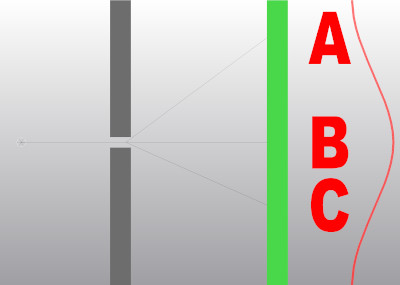
somewhat). In the Figure 2 we can see how wave motion behaves, when it
needs to go through a narrow gap. When the width of the gap is same
than the wavelength, the wave motion spreads into beautiful circular
waves in the back side of the gap(for example, if one uses red light
with wavelength of 700nm, the width of the gap needs to be 0,0007
millimeters wide. Don't use white light in these experiments because
the white light is a mixture of different wavelengths). However, light
is not a continuum like water, but light consists of separate particles
called photons, that know nothing of each other. Let's assume we are in
a dark room and we have a light source and we can weaken the light of
the light source to an extreme minimum, so that only one photon at a
time – which can be sent by the investigator by pressing a button of
the test equipment – will be sent to the gap, how that photon
'decides', should it go straight to the point B in the Figure 2, turn
to the point A or maybe to go point C anyway? We don't know how the
photon makes its decision, but if the green line in the Figure 2
represents photographic film and we send lots of photons through the
gap, the film slowly develops the same regular exposure pattern as
would be created instantly by the strong light: the area in point B is
the most exposed and when going to the sides A or C, the exposure
decreases smoothly as shown by the red line in Figure 2.
Figure 2: Diffraction of light. The light
source is in the left of the picture and the red curve describes the
exposure of light on green photographic film.
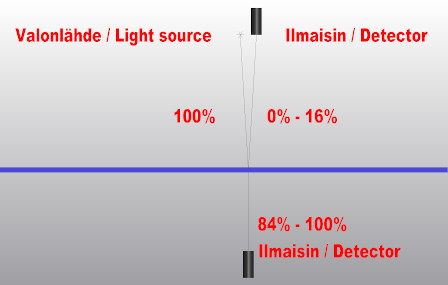
Figure 3: how does a single photon know
whether to reflect or pass through blue glass?
The reader may think that choosing the route the photon travels is just
like casting dice. But it cannot be explained by probability
mathematics, and the next example shall convince the most sceptical
reader. As is well known, glass lets light through but also reflects
light. Even when the light falls perpendicularly on the surface of any
light-transmitting material, only a portion of incoming light goes
inside the material and another portion reflects back: this is called
partial reflection. Similarly, when the the light goes out of
light-transmitting material, a portion of light reflect back into
material and another portion goes out. Let's look at the situation in
Figure 3: depending of the thickness of the blue glass plate, 100% of
the light may penetrate the glass panel and at least – depending on the
composition of the glass and the incoming angle of the light – 84% of
the light will penetrate the glass panel. What the heck, I just wrote
'only a portion of incoming light goes inside the material and another
portion reflects back' and now I'm saying that all the light can
penetrate the glass! Yes, that's true, but previously I was talking
about a single surface like a calm lake surface, but I wasn't talking
about two surfaces (front and back side) like the glass panel in Figure
3. These are completely different cases! Furthermore, if second glass
panel is added below the existing glass panel in Figure 3, the partial
reflection on the first surface will change again. So does this all
mean, that a single photon needs to pluge through all the layers of
glass and look for the last possible surface, before it can 'decide' to
reflect or not on the first surface? And additionally take account, how
many other photons are already gone in the same path and what kind
of 'decision' they did? The ansver is yes, or then there is some
unknown which directs photons onto the right paths, and that is not
casting dice anymore. We don't know how the photon does its 'decision'.
But it is obvious that partial reflection needs a complex, space-aware system in the
background to steer it and we humans are unable to perceive that
system. This kind of system
can exist only in the afterlife.
Problems in the quantum level
"Quantum" in physics refers to the minimum dose or discrete unit
of a particular physical property, such as energy or charge. Photons
are quanta of the light and phonons are quanta of the matter. However,
no quantum can be a particle, but all quanta represent wave motion.
Here I mention quantum to emphasize, that now I'm talking about things
in a sub-atomic level.
When researching the universe or actually the space, cosmologists,
physicists and especially theoretical physicists use particle
accelerators to qualify their ideas. Those test results given by the
particle accelarators or actually particle colliders have been very
important when creating the current, commonly accepted universe model,
which has four dimensions and belongs to the alternative limited and infinite. But do the
conclusions from particle experiments mean, that the universe needs to
be limited and infinite? Or
are the conclusions from particle experiments excluding the alternative
unlimited and finite universe?
In order
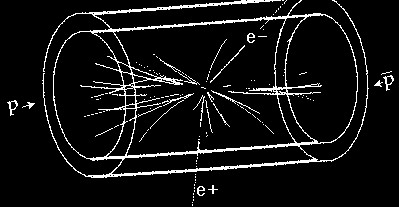
Figure 4:
proton-antiproton collision.
to get an answer to the previous questions, we need to shortly
introduce ourselves into particle tests and Quantum Field Theory, which
is the basis for interpreting the results of particle experiments. The
particles to be collided need to be electric charges, because they will
be accelerated into high speeds by using an electric or electromagnetic
field. The particle is collided with another particle or medium, for
example liquid hydrogen. In the Figure 4 we can see the result of some
experiment: a computer generated model showing the trajectories of
particles created by the collision. By studying these trajectories
scientists try to understand the sructure of the universe. The reader
may disagree, but those particle experiments do not tell anything
whether the universe is infinite or finite in ny opinion. Only
conclusions drawn from experiments do that: scientists have created the
Standard Model of particle physics based on Quantum Field Theory and
experiments. The Standard Model tries to model the universe using six
quarks, six leptons and four interactions. Unfortunately, the Standard
Model is incomplete, because it cannot explain gravitation or predict
the mass of a particle, it has discrepancies with cosmologic
observations and has a group of another unsolved problems. There is
also the suspicious fact that the fundamental principles of the
Standard Model, called symmetry rules, are not based on any
observations, but they are proposals based on nothing: that would of
course be acceptable, if the Standard Model could explain the reality,
but so far it cannot.
It is possible that the conclusions drawn from particle experiments are
wrong. Maybe the assumptions of Quantum Field Theory are incorrect or
Quantum Field Theory itself is incorrect. Quantum Field Theory is based
on operators and symmetry rules that describe the physical laws
associated with the event under study. If this description is made
incorrectly, for example by assuming the universe to be
four-dimensional instead of six-dimensional (seven-dimensional), it is
quite clear that the Standard Model thus constructed cannot correspond
to the structure of the real universe. Of course I'm assuming here,
that the universe really has six (seven) dimensions, which may not be
the case. We are equally lost if we assume that the universe is
self-replicating in structure, but in reality it is not.
Now we can begin to envision a universe that is stable and
self-renewing, and falls into the alternative of an unlimited and finite universe.
Preliminary Draft
If I were God, I would design the universe to be able to renew
itself (This is probably how many people think about God. But it is as
irrelevant to ask who created the universe as to ask what is outside
the universe. If God exists, he must be either a part of the universe
or the entire universe, and certainly not the creator of the universe).
A prerequisite for a self-renewing universe is that it is perpetual
motion: The universe must recycle its own building blocks and convert
the energy it consumes back into a usable form. The universe must have
a closed metabolism. If the universe is not perpetual motion, it is
just an undevelopable, i.e. a repeating, decaying atomistic monolith.
It is generally believed, and I also believe, that perpetual motion is
not possible in the space we know, but let us assume that the entire
universe – the space and the afterlife together – is capable of forming
a perpetual motion machine.
The building blocks in space (but not in afterlife) are various
elementary particles, some of which are matter particles and others are
force particles. But since this text is a preliminary draft, we will
now focus only on larger entities consisting of elementary particles:
such are, for example, elements such as hydrogen, gold, iron and
carbon. In addition to elements, or rather mainly, I am talking about
the building blocks of elements, namely neutrons and protons, which are
made up of matter particles, as well as a matter particle called an
electron and a force particle called a photon. Matter particles are
massive particles and force particles are massless; matter particles
cannot reach the speed of light and force particles cannot move slower
than the speed of light.
Elements heavier than hydrogen and electromagnetic radiation, including
visible light, in space are produced by the nuclear reactions of stars
as a result of fusion reactions, as is well known. In a fusion
reaction, lighter elements combine to become heavier ones, for example,
two hydrogen atoms combine to form one helium atom. However, no
corresponding nuclear fission reactions have been found in space
(radioactive isotopes of elements do decay in nuclear fission reactions
everywhere in space, but this is not enough to form a closed metabolism
in the universe), in which the heavier new elements produced in the
fusion reaction would be returned to their original elements – or to
the element, because it is presumably enough that all matter in space,
i.e. all elements produced in stars, are converted into the lightest
element, hydrogen.
For resource recycling in the universe to work, we must be able to
convert all the elements back into hydrogen, but how could this happen?
I propose resorting to the afterlife, that is, to the two dimensions of
the universe that we cannot observe, and agreeing that the heavier
elements convert back into hydrogen in the afterlife, outside our field
of observation. However, there is a problem here: although a photon can
lose its energy to the afterlife as a function of time, matter cannot.
If atoms spontaneously just disappeared from space in the same way that
radioactive elements decay, we would certainly have noticed the
phenomenon. After all, we also notice how rust destroys the iron
objects we have painstakingly built! Instead of atoms disappearing all
over space on their own time, the atoms' departure to the afterlife
must occur in a way that is consistent with observations made from
space. Thus, the so-called black holes that astronomers have discovered
in space are ideal sinks where atoms end their journey through space
and pass on to the afterlife. This solves the problem of atom
destruction, but the problem of hydrogen reappearing in space also
needs to be solved.
I really like the idea that hydrogen atoms are just being shot at a
steady, random rate all over space. Although it is somewhat plausible
that not whole atoms are being shot into space, but only protons,
neutrons and electrons or perhaps even smaller elementary particles.
But since a neutron alone decays radioactively into a proton and other
particles within about 15 minutes, some kind of coupling is needed for
the formation of a hydrogen atomic nucleus, for example a proton
appearing nearby. The particles appearing in space must be small, also
because they must not cause significant changes to the material that
may be around it, whose velocity difference to the appearing particle
may be large but not more than cosmic velocities (less than some 350
km/s). A single proton is already an ordinary hydrogen atom, which
lacks an electron, but if it meets a neutron, they can combine to form
another isotope of hydrogen, deuterium. Gravity then gathers these
hydrogen atoms over time into gas clouds, which later condense into
stars. In stars, fusion reactions produce helium from hydrogen and then
heavier elements.
So far, I have made one conclusion about the relationship between space
and the afterlife: photons interact with the afterlife because they
slowly transfer their energy there. Later, we will find that the
interaction with matter, or matter particles, is much more diverse. Now
I will generalize this conclusion to apply to all elementary particles,
so that force particles interact with the afterlife only to the extent
of transferring energy that is observed as a redshift, but matter
particles never have a redshift or a blueshift (however, a matter
particle has a very diverse interaction with the afterlife, as we will
find. A matter particle is completely dependent on the afterlife). This
could also be said another way, that elementary particles traveling at
the speed of light interact with the afterlife in the form of a
redshift, but elementary particles traveling slower than the speed of
light do not (although, for example, a photon traveling at the speed of
light travels slower than the speed of light everywhere except in a
vacuum, but let's not let such small facts interfere with drawing big
lines. An explanation for such small problems will be found if the
theory as a whole works).
Dimensions of the Universe
I have claimed that the universe is six-dimensional (or more
accurately, seven-dimensional). Now it is time to justify this claim.
It all starts with the assumption that the space in which we live is,
as a whole, homogeneous (space looks the same no matter from where you
look at it) and isotropic (space looks the same no matter which
direction you look at it). Furthermore, the assumption is that space is
unlimited and finite. The assumptions made require the curvature of
space as a spherical system, which is one of the Riemann
Manifolds.
Since people are usually unable to even visualize a four-dimensional
space-time (I myself can barely concretely visualize a space-time, for
example, I often miss the bus), let alone a multidimensional one. I
will begin my presentation with a one-dimensional space, which is like
an electric wire: an electric current can only flow forward or backward
in it, and it doesn't know anything else, no matter how winding the
wire is. Or does it know? I can't say about electricity, but if space
is winding – regardless of the number of dimensions – then it cannot be
an isotropic space. On the other hand, a linear one-dimensional space
would certainly be isotropic, but it cannot be unlimited. But if the
curvature of space is constant, i.e. there is only one uniform bend
encompassing the entire space, it can maintain its isotropicity,
because the geometric conditions are then the same at every point in
the space. Space must therefore curve in order for a
'straight-traveling spaceship to return to its starting point', but the
amount and direction of the curvature must be the same throughout
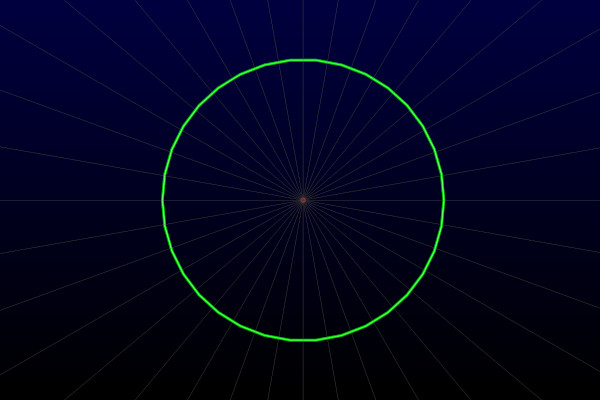
space. Thus, a circle is the basic structure of the universe, requiring
a two-dimensional universe for a one-dimensional space, as depicted in
Figure 5.
Figure 5: One-dimensional space depicted
as a green ring in a two-dimensional universe. The gray lines are
'threads' along which energy can travel in the universe.
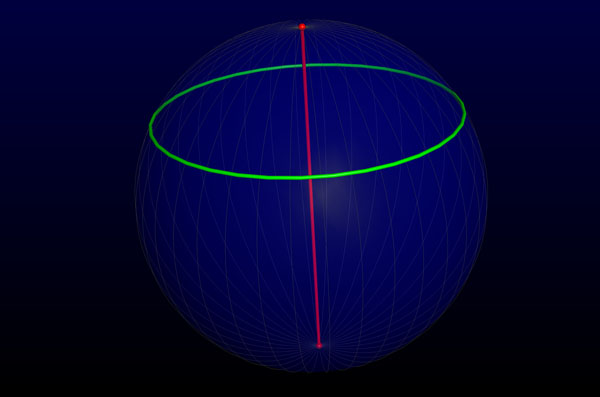
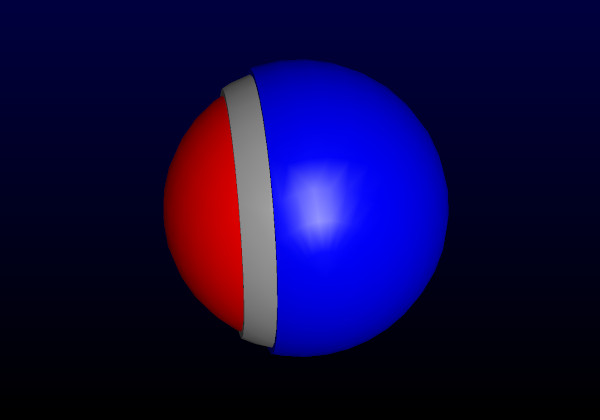
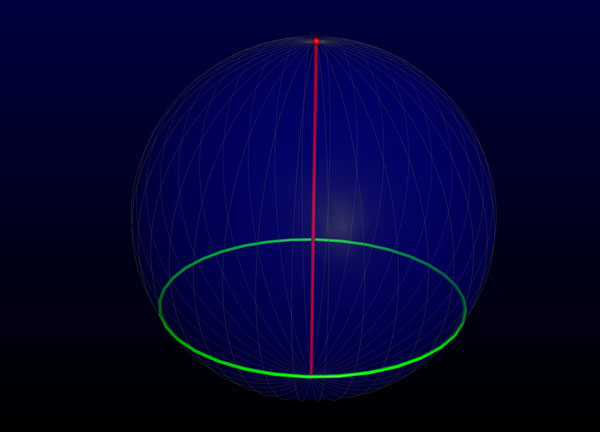
Figure 6: Perspective view of
one-dimensional space (green ring) in a three-dimensional universe.
Energy travels through the green ring along gray 'threads' on a blue
spherical surface. From the 'north pole', energy moves to the 'south
pole' along the red line.
But one 'extra' dimension is not enough, because the universe must have
a closed metabolism: as shown in Figure 5, a circle cuts a plane
surface into two separate parts, and if energy – or material – flows in
the universe from, say, outside the circle through the space of the
circle to inside the circle, then in order to create perpetual motion,
the energy must travel some way back outside the circle. We could of
course think that the energy travels inside the circle at some point
along the arc of the circle and returns outside at some other point
along the arc, or the movement of the energy is a back-and-forth
pulsating motion. None of these solutions are valid if we want space to
be isotropic, homogeneous, and stable, as I want it to be. Therefore, a
second 'extra' dimension is needed, as shown in Figure 6: this way
energy – which I will later call antematter when I'm talking about the
afterlife – can move along the surface of a three-dimensional sphere,
let's say from the 'south pole' to the 'north pole', and from there
return to the south pole along a straight line.
This solution may raise some questions for the reader: Those gray
threads in Figures 5 and 6 are located in the afterlife, but why should
there be energy? Why would energy travel specifically along the
threads? What makes the energy leave the surface of the sphere?
Energy as we know it – or matter, because according to Einstein's
theory of relativity they are the same thing – can only be on the
surface of the sphere, because we can't get anywhere from our space
either, and our space-time is the surface of the sphere according to
the theory of relativity. However, energy leaves the surface
of the sphere at the 'north pole', i.e. in places where there is
sufficient compression, and in our space, the
so-called black holes are like this: from the black hole, the matter of
space moves to the afterlife into those gray threads. In the afterlife,
everything is a kind of energy that I call antematter. There is no
material in the afterlife. The afterlife – or what we can know about
the afterlife, we can’t find out the technical details – is just logic,
and the gray threads are my attempt to describe that logic. That logic
doesn’t allow antematter to flow freely in the afterlife as the
seawater in the oceans. And there must be antematter in the afterlife,
because space cannot exist forever without an external energy source
that constantly supplies fuel – hydrogen – as the raw material for the
stars of space.
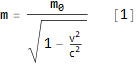
Thus,
We
will never be able to accelerate any object to the speed of light in
our four-dimensional space-time, as this would require an infinite
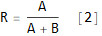
amount of energy, according to the formula below, based on Albert
Einstein's theory of relativity:
When the speed v is equal to the speed of light c, formula
(1) gives an object with a rest mass of m0 an infinite mass. An
infinite amount of energy would be needed to move an infinitely large
mass. But the theory of relativity only encompasses three-dimensional
space and time. Could the situation change if we could somehow utilize
the two dimensions of the afterlife? Accelerating a spaceship to the
speed of light in space, for example from Earth towards the nearest
star, Proxima Centauri, is not possible according to Einstein's theory
of relativity, but could a spaceship be accelerated to the speed of
light in the afterlife? The spaceship would therefore have to be
accelerated 'in place' – whatever that is, and it will be explained
later in this text – to the speed of light, or in vernacular terms, the
spaceship would have to perform a vanishing act.
a one-dimensional space needs a three-dimensional universe and a
three-dimensional space needs a five-dimensional universe. And when
time is added to the dimensions, our universe has a total of six
(seven) dimensions, but I will tell you more about time later. The
shape of unlimited and finite space is therefore always, regardless of
the number of dimensions, a spherical surface: a two-dimensional sphere
is called a circle, a three-dimensional sphere is called a sphere, and
the four-dimensional spherical surface of a three-dimensional space
could be called a 'four-dimensional sphere'. Furthermore, our
four-dimensional space-time according to Einstein's theory of
relativity needs a 'five-dimensional sphere' on the surface of which it
could exist. However, six dimensions are not enough for the existing
universe, just as three dimensions are not enough for the universe in
Figure 6: each needs one more dimension, even though this dimension no
longer serves any purpose. That is why I have written about a
six-dimensional universe in this text and corrected the universe to be
seven-dimensional in brackets. But one more dimension is needed to make
the universe unlimited and finite. For example, the universe in Figure
6 would expand to infinity if it were not enclosed in a circle, and to
achieve this, one more, fourth, dimension is needed.
By the way, in the Bible's creation account, days are dimensions of the
universe. That is why Lord God rested on the seventh day, because the
seventh dimension does not have practical use: "Thus the
heavens and the earth, and all the host of them, were finished. And on
the seventh day God ended His work which He had done, and He rested on
the seventh day from all His work which He had done. Then God blessed
the seventh day and sanctified it, because in it He rested from all His
work which God had created and made." (Book of Genesis, chapter 2).
Space-time, or more simply, space, comprises four dimensions that we
can perceive. But what are the two dimensions of the afterlife? We
already know that they are also closed circles so that the metabolism
of the universe can function. We can know more about them. For this, I
set a condition that the model of the universe outlined in this text
requires the existence of God. In different religions, God is given
different names, such as Lord, Almighty or Allah, if we stick to
monotheistic religions only. Polytheism is excluded in this text,
because God must be omnipotent. Polytheism means chaos, that God does
not exist. By God, I mean a being that has its own will and power to
rule its realm, in this case space. For God to be omnipotent, it must
be able to control every point in space (I did not write every point in
the universe, although that could also be true. But the afterlife is an
organic part of God, while space is God's game board). Since every
point in our space is on the four-dimensional surface of a
five-dimensional sphere, God is able to operate on every point in space
without hindrance, because God himself is at least five-dimensional.
For the control of space to be meaningful, something important for the
entire universe must happen in space. Controlling a mechanical
clockwork that operates in a completely predictable manner is the same
as a controlling ruler who has no subjects to be controlled: that would
be God’s solitude. So space needs beings who have their own will and
the power to choose whether to carry out God’s will or oppose it, i.e.
beings like God. Or, better said, space needs beings who have the power
to choose how to carry out God’s will, because God’s will is fulfilled
by whatever requires it. The fulfillment of God’s will is achieved by
building something in space – and also especially in the afterlife –
that is essential to the functioning of the Universe. Such a lifeline
could be the implementation of the universe's metabolism and the
safeguarding of development. I have already written above about a
different kind of universe's metabolism, about how hydrogen atoms
appear from the afterlife into space, how they change into heavier
elements in the stars of space, and how the heavier elements eventually
return to the afterlife through black holes. In the afterlife, they
would be broken down back into hydrogen atoms and the cycle would begin
again. This metabolism would probably be completely mechanical and,
above all, slow, and no one in space would have to do anything for it.
The task of beings like the God in space – humans – is something
completely different, which will be explained later in this text.
But energy must be transferred through the space i.e. through the
surface of that
five-dimensional sphere, in other ways than just as elements, and in a
completely bigger scale. Energy can only pass through the
surface of the sphere at points where the transfer of energy cannot be
observed from space – otherwise the phenomenon would have already been
observed in one way or another. Thus, the transfer of energy is only
possible in points where there is a material particle in the space, or
the location on the
five-dimensional sphere is somewhere else than in the absolute present,
i.e. in the past or future (if the absolute present sounds strange,
don't worry, I'll tell you more about time soon). The transfer of
energy through space occurs in such a way that some particle in space,
for example an electron, acts as a bridge, i.e. as a mediator of energy
through space. On the other hand, as the random appearance of hydrogen
atoms in space shows, energy may transfer through space without a
single particle in space, as long as the necessary particle is first
created. This solution imposes certain conditions. Gravity and other
physical interactions as we know them and as Einstein's general theory
of relativity suggests can only exist in space, but not in the
afterlife: otherwise we would be able to move and see into the
afterlife dimensions. Furthermore, energy cannot take on material form
in the afterlife, but must remain in a light-like state. Light-likeness
means that energy must move in the afterlife at the speed of light and
without rest mass, just like photons. Or else energy is absolutely
stationary in the afterlife, when it cannot move through the space. In
terms of motion, the afterlife is an on-off world, just like photons
are in our space.
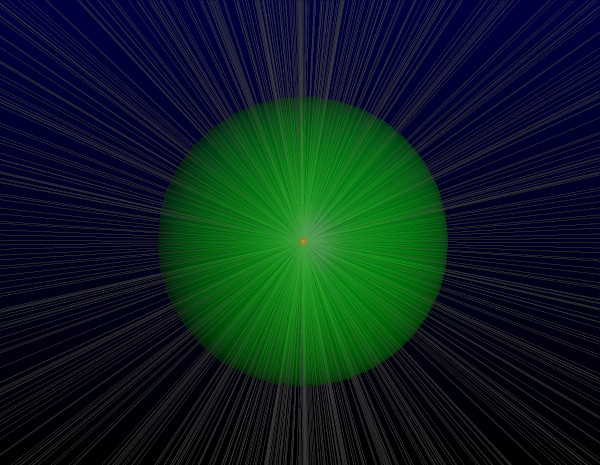
The
Figure 7: In the perspective view, a
two-dimensional space in a three-dimensional universe. The gray rays
represent threads.
above-described arrangement gives God the tools he needs, on the
one hand, to observe material in the space based on where energy passes
through current-time-space or where photons give up their energy to the
afterlife, and on the other hand, to control space by forcing the
passage of energy even when energy would not otherwise pass through
space. For complete – or rather almost complete – control of space, God
would still need a way to prevent the passage of energy when energy
passes through present-time-space without forcing it, i.e. when there
is a suitable particle at that point in space. God does not necessarily
have such a means, as it would mean the disappearance of electric
charge from present-time-space, but something comparable to it is
possible: God is able to control the location and time of massive
particles and exchange a massive particle for another similar one. As
Figure 7 tries to show, the dimensions of the afterlife do not behave
in the same way as the dimensions of space: in the afterlife, the
dimensions do not allow energy to move parallel to the four-dimensional
surface of a five-dimensional sphere, but only perpendicularly through
the surface of the five-dimensional sphere. On the other hand, on the
surface of a five-dimensional sphere i.e. in space-time, material and
also energy in forms we can observe can only move parallel to the
surface, never intersecting the surface. The two dimensions of the
afterlife are filled with threads along which energy – the antematter –
can move, but nothing can be transferred from one thread to the other.
A thread is like an electric wire along which energy can be sent and
received: along the threads God has a two-way connection to every point
in space (the thread is here merely an image, and not a real structure:
in the afterlife, energy is like light, and as we know, light always
travels between two points along the most direct path, which hopefully
suffices to explain the forced paths of energy in the afterlife).
The reader may wonder how massless energy from the afterlife could,
after reaching space, turn into, say, an electron? I have no other
answer to this question than that it could be possible. On the other
hand, the idea of why we do not see the afterlife, if light or some
similar energy comes from there, is easily explained: as a rule,
nothing comes into space from the afterlife, unless it replaces
something leaving space. And in order for us to be able to see the
afterlife, photons would have to travel from the afterlife to space,
but since travel in the afterlife is only possible along threads, a
photon coming from the afterlife would travel perpendicularly through a
four-dimensional surface to the inside or outside of a five-dimensional
sphere. Then it cannot be observed in space except for the absolutely
shortest moment that exists in the universe, at a single point in space
(and of course, by looking that specific point at the right time from
elsewhere, does not make possible to see a photon coming from the
afterlife!). It should be noted that all the building blocks of space,
i.e. all elementary particles, both force and material particles, are
transferred from space to the afterlife and back from the afterlife to
space in the metabolism of the universe, but some elementary particles
and larger entities built from elementary particles, for example atoms,
can only exist in space. The reason for this is already mentioned above
that in the afterlife everything moves at the speed of light, so there
cannot be objects moving slower than the speed of light there – unless
the object is absolutely still. There are also other reasons, but it is
not worth opening them here.
The functioning of the universe and the existence of material in space
must therefore be based on the passage of energy through space, so that
God would have the opportunity to control space. But why in this
picture do beings with their own will and freedom of choice need to
exist? And what should these beings do in space in order for the
universe to come true? I wrote above that the universe is a generator
of variation capable of transformation, and not some decayin monolith:
the space of the universe must develop in much the same way as the
biosphere or topography of our home planet Tellus. Space changes
evolutionary, just as the development of life also occurs through
evolution, but the evolution of space does not occur in the way like
the organisms of Tellus – humans, animals and plants – evolve, mating
with each other. In the evolution of space, the physical laws of space
are changing, and since the laws of physics must be exactly the same
throughout the space, the evolution of space cannot be guided by local
conditions, as happens in the evolution of living creatures. Therefore,
only
beings who are capable of figuring out the structure of the universe
for themselves and who therefore have a built-in premonition of God's
will, i.e. are God-like, affect on the evolution of space. Such
beings, who have both knowledge of the local conditions of their
environment and of God's will, can organize their own lives in such a
way that it has an impact on the development of the universe to the
extent of their own contribution. But in order for that contribution to
be taken into account, the civilization of the being in question must
develop to perfection, as will be explained later in this text (in this
text, civilization refers to the population of a god-like being born of
life that spontaneously originates on a random planet, from its first
individual to the last, extinct individual).
What is time?
Perhaps the most challenging of the six dimensions of the
universe, time, has yet to be addressed. The universe must implement
Einstein's general theory of relativity, and there time is conceived as
parallel to the dimensions of length, width, and height (the reader
should familiarize himself with the General
Theory of Relativity
before reading any further this text). This means that time is
confined to the four-dimensional surface of a five-dimensional sphere
as one of the four spherical coordinates on the sphere, the other three
spherical coordinates representing length, width, and height, and none
of these four spherical coordinates representing the radius of the
sphere. In other words, just as a spaceship traveling perpendicularly
through space would eventually return to its starting point, even when
stationary (actually, it is not stationary with time coordinate, but
travels along the time to stay in the present-time-space) it would
return to its past after some – long – period of
time. But returning to the past cannot mean that 'history repeats
itself'! We can think that returning back in time does not repeat
history if there is no history in the time-space or history covers only
a limited part of the past, and the
older part of the past is permanently lost, becomes 'rewritten'. The
model of the universe described in this text contains a history of the present moment of
space. But is this idea of history
really possible?
Does the universe need a memory, or is time just an
ever-dynamically advancing present without the need to remember its
past? The past determines the present, but can it be possible that the
future also determines the present? Does a spaceship disappear from
space when its time is full? This text provides a more or less
exhaustive answer to these questions.
It is clear that we cannot assume that matter has some 'due date' after
which it simply disappears from space, because we would have observed
this phenomenon in our everyday lives. Instead, matter disappears from
space in black holes, as discussed above. But since I assume that time
is a finite dimension on the surface of a five-dimensional sphere, history must leave space before its
time is full, that is, before the present
has traveled too long on the surface of the five-dimensional sphere.
This journey is only a fraction of the circumference of the sphere, and
on the surface of the five-dimensional sphere there are several
absolute present moments,
which are like meridians on a globe and theyrevolve around the sphere,
let's say counterclockwise: let's call the entity related to one absolute present a driftwood group.
A driftwood group has a history and its maximum dimension is such that
different
driftwood groups cannot come into contact with each other. In
principle, there could be only one driftwood group in the entire
universe, as we will see later, but that would be a waste of a
five-dimensional sphere and would cause spherical geometry problems
anyway, so let's just assume that there are multiple driftwood groups.
Going back in time or moving forward in time to the future cannot be
possible, because Einstein's theory of relativity does not allow it,
and especially not the structure of the universe that I am currently
presenting.
Relative Time
People who have been to school know that according to Einstein's
theory of relativity, time is a relative concept that runs slower the
faster the clock in question moves in space or the stronger the
gravitational field in which the clock is located. Time running at
different speeds must be taken into account in a very concrete way, for
example, in GPS satellite positioning, when clocks run at different
rates in satellites and on the surface of the earth. This relativity
applies to everything in
space, including elementary particles, not
just man-made clocks! But what if the clock is absolutely still in some
distant empty region of outer space? The scientific community considers
this question to be heretical, because according to the prevailing
understanding, there is nothing absolute in space, which is complete
nonsense: the idea of the relativity of everything in space can be
shown to be contradictory and false with a simple mental game, as shown
here. This text follows Einstein's
special and general theory of
relativity with certain exceptions, one of which is that it is possible
to be absolutely stationary in space. Thus, time for a clock that is
absolutely stationary in empty space passes at the fastest possible
rate, which is constant throughout space and the same as absolute time,
which will be introduced later.
So an elementary particle appears from the afterlife onto the
four-dimensional surface of a five-dimensional sphere, the space-time
of Einstein's theory of relativity. The location of the appearance of
an individual particle in space is random, but the time is such that it
fits into the absolute present
moment of some driftwood group.
Once a
particle has appeared in space, its time calculation begins immediately
and is unique to that particle according to Einstein's theory of
relativity. The reason why an elementary particle can only exist in
space for a finite period of time can be found in the theory of
relativity. According to it, each particle has a time dimension, which
is the difference between the particle's
relative time and absolute
time: the length of the time dimension of a massive particle
must not
exceed the maximum time that space can offer it. Later in this text,
however, we will notice that a particle does not actually need any time
dimension, but only the present moment: the particle's time dimension
is only an abstraction needed for relativity calculations. Even later,
we discover that a particle may
actually need a time dimension, but not
because of the theory of relativity, but to record its history as it
relates to someone's soul.
Absolute Time
The relative time presented above is the time that we know in our
everyday lives and that we measure with clocks and from the movements
of celestial bodies. However, the question now arises that if relative
time only exists in space, i.e. in a part of the universe, how can the
universe function at all? If particles come from the afterlife and
later return there, even in large entities through black holes, there
must be processes in the beyond that break all particles into
antematter, build protons, neutrons and electrons from the antematter
and evenly distribute the particles back into space. Such processes
require a continuum, a step-by-step progression, i.e. time. Absolute
time is another exception to Einstein's theory of relativity.
So, in addition to relative time, the universe needs another time,
absolute time. It is one of
the six (seven) dimensions of the universe.
When an elementary particle appears from the afterlife onto the
four-dimensional surface of a five-dimensional sphere, it moves all the
time on the surface of the sphere at the pace of absolute time in the
absolute present moment of some driftwood group. Let us think of
absolute time as the clock frequency of a computer: the universe is
like a computer program that continues to execute on the computer at
the pace of the computer's clock frequency. Therefore, absolute time
does not need its own dimension in the universe, but uses the same
dimension as relative time, which is just one dimension among the six
other dimensions of the universe (in reality, the time dimension of
relative time is used by absolute time and relative time does not need
its own dimension. This confusing contradiction is due to the fact that
I am approaching the solution through Einstein's theory of relativity
and at some point the reader has to figure out how to turn things
upside down). We cannot measure absolute time, because the only time we
can measure in space is relative time. Nevertheless, everything that
happens in the afterlife and in space happens at the pace of absolute
time.
Absolute time is dominant over
relative time. As is known, according to Einstein's theory of
relativity, both time and length are relative concepts in space: for
example, the passage of relative time stops completely in an object
that travels at the speed of light, and in an object that is
stationary, relative time progresses most rapidly. Since a photon moves
at the speed of light, the decrease in the photon's frequency described
above thus occurs as a function of absolute time. The redshift of
starlight therefore does not follow the theory of relativity! Instead,
an object that is stationary in space or moves at a speed slower than
the speed of light experiences relative time, and the faster the time
goes the slower the object moves. If the object is absolutely stationary, relative time progresses most
rapidly and as quickly as the absolute
time.
Absolute Present
Absolute time, although it can be thought of as a computer clock
frequency, it is however difficult to implement (unlike relative time,
which turns out to be a fairly simple solution). So difficult that I am
not even sure if it can be made to work satisfactorily in spherical
geometry. The difficulty is concretized in the concept of the absolute present: absolute time
must proceed on the surface of a five-dimensional sphere, which means
that time revolves around the sphere. We notice that the speed of time
cannot be constant on the surface of the sphere, but is maximal at the
equator and zero at the poles. This problem is probably the greatest
weakness of my universe model. The possible solution to this problem is
to
divide the surface of the sphere into different regions, driftwood
groups, within which the speed of time is sufficiently constant. The
driftwood groups wander on the surface of the sphere at the rate of
time.
Inside each wandering driftwood group there is a continuous line
(actually it is a continuous three-dimensional space, but since we
humans cannot imagine a five-dimensional sphere, I will limit my
thinking to a three-dimensional sphere, in which case a line is used
instead of volume), a front advancing with time: the absolute present.
We, the inhabitants of Tellus, and the entire space we observe belong
to one such absolute present of the driftwood group. The most distant
galaxies, whose light has set off towards us billions of years ago,
also belong to the same absolute present with us. We notice that space
is very empty: the space we observe, the absolute present of one
driftwood group, is already in itself primarily empty space with
celestial bodies here and there, but the rest of the space of the
driftwood group, which does not belong to the present, is just far more
empty! Or is it? What if the past is recorded there? No, but time is an
ever-dynamically advancing present, which does not record its past in
space, but in the beyond to the extent necessary, which will be
explained later (however, the past of space is 'reserved' insofar as
what is stored in the afterlife representing that point in space-time).
Nevertheless, the other area of space, which does not belong to any
absolute present, does not stay empty: all the internal communication
of the afterlife that takes place between the inner and the outer of
the five-dimensional sphere takes place there.
The reader may want to ask, what exactly makes time pass, i.e. the
absolute present moment rotate on the surface of the sphere?
Unfortunately, this text does not provide an answer to that. I have
thought about various solutions to this, but none have seemed
reasonable enough for me to attempt to write them here.
Interactions and the Evolution of
the Universe
The reader has probably been disturbed by my cheerful mixing of
Einstein's relative worldview with my own absolute worldview. How could
the universe be both absolute and relative at the same time? Space is
such a seemingly relative part of an absolute universe, and its
relativity is in accordance with Einstein's general theory of
relativity, with minor exceptions. If the universe were entirely
relative, there could be no absolute part in it. But since the universe
is entirely absolute, it can contain a part from within which
everything appears relative.
In
According
to the theory of relativity, time passes at the same rate between two
different objects only if they are stationary relative to each other.
However, if one of the objects is moving, like the spaceship in the
picture,
time passes more slowly in a moving object than in a stationary one.
But what if the moving spaceship in the picture happens to be moving
exactly the same direction and at such a speed that it is absolutely
stationary in space? Then time should pass at its fastest pace
precisely in the spaceship and not on the planet from which it set off!
Yes, but it is worth noting that if the spaceship turns around and
returns to the planet, the end result is that the spaceship's clock is
behind the planet's clock, meaning that time as a whole passed faster
on the planet.
Einstein's theory of relativity, there is no such thing as an
'absolutely stationary object', but objects can only be compared to
other objects: thus any object can be considered stationary, for
example the sun is often thought to be stationary and the planets to
orbit the sun – although in reality the sun also moves in space.
Instead, when this text speaks of an 'absolutely stationary object in
space', it really means an object that is absolutely stationary in
space-time, of course excluding the time dimension. But even if the
object is absolutely stationary, it must still move on the
four-dimensional surface of a five-dimensional sphere with respect to
the time dimension. And if we humans were to observe the object in
question in space, we would find it to be in constant, changing motion
in the same way that a mirror image on the surface of wavy water is in
constant motion; However, this movement would not be due to the gravity
of celestial bodies or the like, but the object would have to move
itself in order to remain absolutely still on the surface of a
five-dimensional sphere in terms of longitude, latitude, and altitude
coordinates.
So far, I have focused mainly on the dimensions of the universe, but a
working model of the universe also requires a comprehensive explanation
of the forces acting in the universe and the materia in the universe.
Of the four known interactions acting in the universe, I will only
discuss gravity and the electromagnetic interaction, because we can
only observe their effects in our everyday lives. I will not discuss
other known interactions, the strong and weak interactions. The strong
and weak interactions operate at the atomic level, and we have no
direct observations of their existence, so it is even possible that
these forces do not exist. However, I do not want to take a position
for or against the strong and weak interactions, but will leave these
forces unexamined. With the accuracy with which I present my own model
of the universe here, I can achieve a complete presentation even
without the strong and weak interactions.
The material in the space, from which people and their environment and
all celestial bodies are built, consists of elements such as gold, iron
or carbon, and these in turn consist of protons, neutrons and
electrons. In this text, I call the matter of space as material. According to Einstein's
theory of relativity, material
always moves slower than the speed of light and according to me material comes from the afterlife
and returns back to the afterlife.
Instead, in the afterlife, matter must move at the speed of light or be
absolutely still, and in this case I call the matter antematter. Instead of the words
material or antematter, you can just as well use the word energy,
because they are the same thing. With the difference that material
always has a structure and antematter most often does not have a
structure, but with the word energy I do not take a position on whether
it has a structure or not. In addition, the reader should know that
this text's name antematter
is in no way related to the antimatter
conceived by physicists, a concept that does not exist in the universe
at all according to this text!
Antimatter differs from matter in more ways than just its speed of
movement: First, it has no rest mass, so it can move from place to
place instantly at the speed of light and back again. Second, matter
has a structure, or the order in which protons, neutrons, and electrons
are arranged, but in principle, antimatter is a structureless 'raw
material' from which any matter that is needed in space at any given
time can be built. This is, of course, in contradiction with the
elementary particle theory of the Standard
model,
because according to
the Standard Model, the universe is built of 12 different types of
elementary particles. But in order for 'anything' to be built from
antimatter, there must be only one type of elementary particle in the
afterlife, from which all other particles and larger structures are
made (we will later see that it does not make sense to think of
antimatter as consisting of particles). Instead, there may well be 12
different elementary particles in space, all of which are built from
the only type of particle in the afterlife, antematter. On the other
hand, antematter can also have structure in certain cases, but we will
get to that later.
Gravitation and Electrical Interaction
As I have said above, space is the surface of a five-dimensional sphere
in the universe, and the present moment of space is a 'longitude'
moving on the surface of this sphere. In order to renew itself, the
universe must constantly move antematter, or energy, through the
surface of the sphere: only in this way can the perpetual motion
machine remain in operation (there are also black holes in the space
and their recycling of material, but that's different case). But how
does antematter move through space? Would it happen that a single
elementary particle of a single atom moves into the afterlife on the
other side of the sphere and is replaced by another particle from the
afterlife at the other side of the sphere? Or would the same particle
always remain in space and act as a 'conductor' for the flow of energy?
And is the direction of movement from the outside of the sphere to the
inside, or vice versa, or perhaps in both directions? And why should
this transfer of antematter through the sphere take place specifically
in the absolute present and not in the past or future?
To get answers to the previous questions, we need to study
interactions. I assume that all interactions in the universe have the
same origin and I also assume – actually wrongly, but I am not trying
to present a complete model of the universe, but only a sketch – that
only gravitation and electromagnetic interaction exist in the universe.
I also assume that the particle mediating the interactions in space is
always a massless photon moving at the speed of light. The same origin
for all interactions means that they are in fact one and the same
interaction, which manifests itself in different ways, for which it is
customary to use different names, such as gravitation or
electromagnetic interaction. Let us call this one and the same
interaction as gravity, since
gravity i.e. gravitation realizes the interaction in the most
simplified way.
So I argue that gravity, that
familiar force of gravitation that keeps you on the surface of the
earth and makes celestial bodies move in their orbits, is the only
interaction in the universe and also includes electromagnetic
interactions. Thus, gravity
governs the universe both in space and in the afterlife. But just as
gravitation and the electromagnetic force are different in their
properties, gravity in space and gravity in the afterlife are also
different things. In fact, gravity in the afterlife is the supporting
force of the entire universe, of which gravitation and the
electromagnetic force are applications. In this text, gravitation means
gravity in space.
The electromagnetic force actually contains two forces, to be precise:
an electric field and a magnetic field. However, in this context, the
distinction between electric and magnetic fields can be ignored, as
both require an electric charge to generate them, and it is sufficient
for us to understand the mechanism by which electric charge is
generated.
But let's start with gravitation and forget about electromagnetism for
a moment. According to the generally accepted understanding, objects with mass have an attractive
property called gravitation. Let's rewrite the previous sentence
in a slightly different way: according to the generally accepted
understanding, material has an
attractive property called gravitation. However,
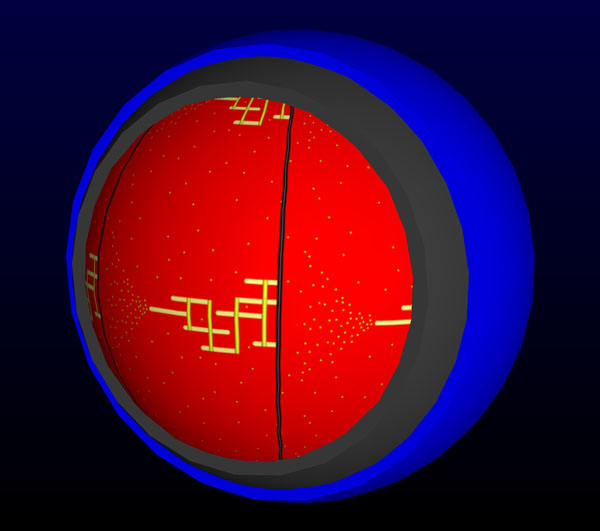
Figure 8: Origin of space
interactions: The space interactions, gravity and electromagnetic
force, are created in an inner gravitational shell (red shell) and an
outer gravitational shell (blue shell), between which our spacetime
(gray shell) lies. Each gravitational shell is capable of adjusting
gravity individually for each thread.
we do not know
what causes gravitation, but the scientific
community assumes that it is a property caused by material. In this
text,
gravitation is not assumed to be a property caused by matter, but I
propose
that a center of gravitation can be created even in a vacuum! Of
course, it
must be added right after that that the center of gravitation almost
always
contains matter, which appears there from the afterlife when the center
of
gravitation is created. But in space-time there can also be material
without
gravitation or gravitation without material. Material only feels
gravitation, but does
not cause it. The initiator of gravity is the surface in the afterlife,
immediately outside and inside the surface of the five-dimensional
sphere, i.e. space-time, which makes the surface of the
five-dimensional sphere three-layered: the innermost shell is the cause
of gravity inside the sphere, the intermediate layer is space-time and
the outermost shell is the regulator of gravity outside the sphere, as
shown in Figure 8. Of these, the innermost shell and the outermost
shell belong to the afterlife. When the outermost gravity shell
switches the thread on to gravity at a single thread, gravity moves the
antematter that is absolutely stationary in the thread to the speed of
light to travel towards space. If the innermost
gravity shell
also simultaneously starts its own gravity at the same single thread,
the antematter from this other side also moves towards space, and the
antematter coming from opposite directions collide with each other in
space and the course of both stops there, changing the antematter in
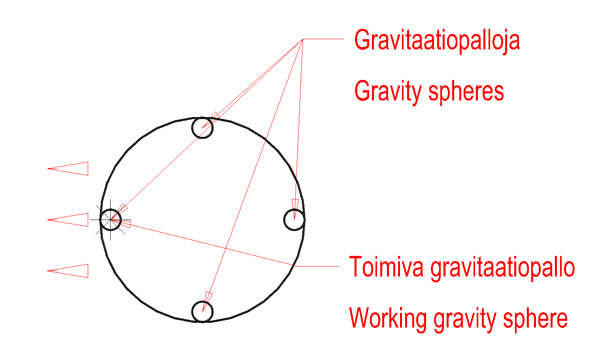
space into material. Then the gravity shells switch off the
gravities. A neutron or a similar massive and non-electric particle was
born in space, but the particle in question does not yet have a
gravitational field.
Gravity is a force acting in the threads that constantly tends to move
antematter from the outside of the five-dimensional sphere to the
inside. That is why the inner and outer gravity shells are structured
differently: The outer gravity shell acts only as a regulator of the
gravity acting in the threads, a kind of valve that lets antematter
into space when needed. Instead, the inner gravity shell has to
generate by itself the gravity it needs to move antematter from the
inside of the sphere towards space.
The reader is probably wondering why gravitation and material need to
be separated? Why can't we simply assume that gravity is a property
caused by matter? The reason for this comes from Einstein's
theory of relativity, which requires that material, which is the
source of
gravitation in relativity, must have a time dimension. In other words,
material consists of massive particles and each of them has a time
dimension, along the length of which there is a present moment common
to all particles. This is how it is according to Einstein's theory of
relativity, which only encompasses the four dimensions of space.
Furthermore, in this text I assume that all material in space has an
absolute present moment common to all matter. But since the universe is
actually six-, or more correctly seven-dimensional, we do not need to
imagine any time dimension for materialr, which is logically
contradictory to the behavior of light and therefore impossible to
realize. Instead, we can simply assume that gravitation or any other
force effect is not a property caused by material: it is a creation of
the gravity shells of the afterlife. This allows us to make it possible
for different particles to pass time at different rates, as required by
the theory of relativity, since the passage of time is measured by the
frequency of occurrence of events. For example, if a particle emits a
photon at certain intervals, i.e. at a certain frequency, gravity
shells as massless photon initiators can slow down the sending
frequency, causing the particle's time to pass more slowly, as required
by the theory of relativity. This way we get rid of the cumbersome time
dimension of matter, but we can preserve the absolute present moment.
If a particle has mass, like a neutron, it should naturally also
have a gravitational field. To make a gravitational field possible,
let's agreed that the mass of a massive particle is quantized, in other
words, only masses of a certain magnitude are possible for a massive
particle. After all, a gravitational field needs a massless
intermediary particle in space: the scientific community talks about
gravitons, but in this text I will call all intermediary particles
photons. If gravity shells couple a gravitation to some strength that
is not exactly the same magnitude as some massive particle, the excess
forms a gravitational field. Or if gravity shells couple a gravitation
to some strength that is smaller than the lightest possible massive
particle, a mere gravitational field is formed into the space without
matter. Gravitation spreads from the thread into space as a
gravitational field at the surface of a five-dimensional sphere, i.e.
the center of gravitation at that point in space sends massless
particles, photons, into three-dimensional space around it (photons do
not spread into the time dimension, as they can only exist in the
absolute common present).
The center of gravitation creates a gravitational field by sending
massless particles around it. There are two things involved in this:
First, according to Einstein's general theory of relativity, the
gravitational field bends the geometry of space, which also causes
photons to change their direction of travel towards the center of
gravitation. Photons are massless particles, which, among other things,
act as the mediator particles of gravitation (in fact, gravitons are
the mediator particles of gravitation, but in this text I consider all
massless particles to be photons), and they cannot interact with each
other, because otherwise the laws of optics and wave motion would be
reversed. Thus, the only possibility that allows the path of a photon
and therefore also visible light to bend in a vacuum, to deviate from a
straight line, is that the threads piercing the surface of a
five-dimensional sphere are denser in the vicinity of the center of
gravitation than in areas that are far from the those; gravitation
changes the geometry of space. Secondly, there is no point in creating
a gravitational field or any other force field just to shape the
geometry of space: that is why material feels gravity, even though it
does not cause it. But how could 'feeling' be implemented in practice?
Naturally, a photon must collide with, or be absorbed by, a massive
particle, but what after that? When it comes to gravitation, a massive
particle should change its course in the direction from which the
photon arrived. However, the massive particle is trapped in the thread
that maintains the particle's gravitational field, so in order to be
able to move in the direction of the photon's arrival, the thread that
maintains the gravitational field must change. In order for gravity
shells to know which thread to turn gravitation off and which to turn
on, they really need a redshift to transmit information!
Furthermore, it is worth mentioning that the Lorentz contraction of
Einstein's theory of relativity can be implemented in such a way that
particles moving in the same direction approach each other in the
manner required by Lorentz contraction by gravitational shells: since a
massive particle is trapped in a thread that maintains its
gravitational field, the gravitational shell can guide the particles
into the formation required by Lorentz contraction. However, I
Because
my own view of gravity differs so much from the generally accepted
model of gravitation, I will list the features of my gravitational
model:
A
center of gravitation can be created in a vacuum by humans. On the
other hand, the rest mass of an object can be removed, i.e. the object
can be made massless. I will explain later how this is possible.
The
origins of gravity are in the afterlife, and each point in space has
its own thread, shown in Figure 7, which has its own individual gravity
strength without any effect on the strengths of neighboring threads.
Gravity
is divided into two components in each
thread at the surface of a five-dimensional sphere: the internal and
external components of the five-dimensional sphere. If the magnitude of
the internal and external components of the sphere is the same and
greater than zero, there is a center of gravitation and/or a massive
particle at that point in space. If the magnitude of the internal and
external components of the sphere is not the same, there is both an
electric charge, the magnitude of which is the elementary charge, and a
center of gravity and a massive particle corresponding to the weaker
component.
If there is not a massive particle present in the
space, there is no electric charge.
The mass of a massive particle is quantized: only
certain strengths of gravity can form a particle in space, the excess
gravity forms the center of gravitation.
Gravity
is always an attractive force: the internal and external gravitational
components of a five-dimensional sphere tend to pull antematter through
the surface of the sphere, i.e. space, to the opposite side of the
sphere. The flow of antematter, i.e. energy, through space is therefore
only possible when there is an electric charge in space at the point of
the thread in question.
will not discuss this topic in more detail, but it is time to move on
to the secrets of electromagnetism.
The creation and existence of an electric charge, i.e. a proton or an
electron, in space is somewhat different from that of a neutron or a
massive particle. An electric charge is created when energy, i.e.
antematter, flows through space, i.e. through the surface of a
five-dimensional sphere, either from the outside to the inside or vice
versa. Since the flow of energy through space always occurs at the
speed of light, the electric charge created can only be of the
magnitude of the elementary charge, i.e. 1.6021*10-19
Coulombs: the
amount of energy flowing has no effect on the magnitude of the
elementary charge. A positive electric charge is created when the outer
gravity shell switches on gravity for the shortest possible
moment in some thread, whereby antematter flows from the outside of the
five-dimensional sphere through the surface to the inside of the sphere
for that moment. Negative electric charge is created by the inner
gravity shell. When only one gravity shell is active, no matter or
gravitational field is created in space. The reason why an electric
charge – unlike a particle – only exists for a moment in absolute time
is due to the movement of the electric charge in space-time, especially
in relation to time, but almost always also in relation to place:
absolute time (from now on I will only talk about absolute and not
relative time. If the change confuses the reader, it is worth reading
the text again from here
on) is one of the four dimensions of the
surface of a five-dimensional sphere. Even if the charge were
absolutely stationary in space, it must still remain in the present
moment, which means continuous movement on the surface of the
five-dimensional sphere. Therefore, the thread that maintains the
charge must change all the time, i.e. gravity is connected to a single
thread only for a moment. Instead, the particle in space simply moves
with time.
But charges, such as protons and electrons, also have mass and matter.
For example, to create a proton, both gravity shells need to be
switched on in the same thread, in order to get matter into space to
create the proton's material and gravitational field, as explained
above. To create material, both gravitational shells connect the same
thread with equal gravity for the shortest possible time. The
gravitational field is created and maintained in the same way as an
electric charge, but the gravity of the weaker of the gravity shells
determines the magnitude of the gravitational field: to create an
electric charge, one of the gravity shells connects a greater gravity
to the thread than the other. The difference in the strength of the
gravities connected by the gravity shells does not affect the magnitude
of the electric charge, which is always an elementary charge. Instead,
the magnitude of the difference in the strength of the gravities
connected by the gravity shells is directly proportional to the
magnitude of the energy flux passing through the surface of a
five-dimensional sphere.
We still need to come up with an explanation for the fact that if
antematter can only move at the speed of light or be absolutely still,
how is it possible to adjust the strength of gravity steplessly – or
even in multiple steps – in a single thread? How could the flow of
antematter into space or just through the surface of a five-dimensional
sphere into the afterlife be adjusted like the flow of water in a
garden hose? The only possibility that comes to mind for this is the
discreteness of the entire universe, where the absolute time of space
progresses in steps many orders of magnitude longer than the time of
the afterlife: if, for example, the shortest possible moment of time in
space corresponds to, say, a million shortest possible moments of time
in the afterlife, we get a million options for an 'almost stepless'
scale for adjusting the flow of antematter in gravity shells.
Now it is time to find out in which direction energy moves through the
surface of a five-dimensional sphere, inside or outside the sphere. As
mentioned, except for black holes, the only way for energy to move
through the surface of a sphere is through electric charges (there is
also a third way, but it is very rare). As antematter, or energy,
passes through the surface of a sphere, it possibly – but by no means
always – acquires structure, in other words, it carries information
about space with it and attaches to the inner gravity shell. At some
point, this information must be destroyed, i.e. the antematter must be
detached from gravity shell and returned to its unstructured 'raw
material'.
At the origin of the five-dimensional sphere of the universe, there is
a singularity similar to that in space-time at each center of gravity,
where gravity has a connection from four-dimensional space-time to the
fifth dimension (we call these centers of gravity black holes). At the
origin of the five-dimensional sphere, the five-dimensional threads of
the beyond have a connection to the sixth dimension, the 'north pole'
of the six-dimensional sphere. The 'north pole' would be a good fit as
a sink where the antematter eventually loses its structure and is
distributed evenly across all strands. Thus, energy moves from the
outside of the five-dimensional sphere to the inside, i.e. in the
direction in which the positive electric charges – protons in practice
– move the antematter.
More structureless antematter comes outside the five-dimensional sphere
through the 'south pole' to replace the energy that has passed through
the surface of the sphere. Of course, energy also moves through the
surface of the sphere in the opposite direction through negative
charges, but the amount of that energy is a fraction of the energy
transferred by positive charges, and the antematter transferred through
negative charges never takes on a structural form.
This is how gravity and electromagnetic interaction are explained.
In fact, I could hastily think of an explanation for the strong
interaction as well, saying that it is unnecessary: the strong
interaction holds the mutually repelling protons of the atomic nucleus
together, but it is not needed if the gravitational shells do not
simply move the protons further apart. However, I do not claim that,
because I have not studied this enough. In any case, the weak
interaction remains unexplained in this text.
The Evolution of the Universe
We have gained an understanding of how the universe renews itself, i.e.
is perpetually moving. But in the universe – or more precisely, in
space – evolution also occurs, the constants of nature change and thus
the laws of nature are modified. The key factor in evolution is
gravity, or more precisely, the density of the threads on the surface
of a five-dimensional sphere: we have already established that near the
center of gravitation the threads are more densely packed than in
regions of space far from the centers of gravitation. It is easy to
extend this rule to the fact that a total weakening of gravity causes
the threas to move away from each other everywhere on the surface of a
five-dimensional sphere, which is only possible if the radius of the
sphere increases. Correspondingly, if gravity increases everywhere, the
size of the sphere decreases. The change in the size of the sphere
directly affects the magnitude of the gravitational constant and
probably also the elementary charge in space (a change in the magnitude
of the elementary charge requires that the speed of light, as a natural
constant, also changes), which understandably has dramatic effects on
the world in our space. But as a slow change, as evolution, the change
of the world is inevitable, because the universe is a variable
generator capable of transformation.
Based on the above text, God's position in the universe is quite
obvious: God is the two gravity shells between which space
exists. The gravity shells could be thought of as two hemispheres
of God's brain, with the space between them as the connecting corpus
callosum. It is precisely such an information-processing, thinking
entity – God – that is needed, for example, to determine the common
present, partial reflection (Figure 2), relative time, and Lorentz
contraction. The reader may be greatly disturbed by the fact that I
explain incomprehensible mysteries such as partial reflection by God's
intervention, in other words, I do not tell what happens in partial
reflection, but I enclose the phenomenon in a box called God. However,
the procedure should not be any more disturbing than the statement of
Richard Feynman, the creator of quantum electrodynamics, about partial
reflection: "It delights me that in order to understand nature one has
to resort to such strange rules and strange logic." The only thing that
separates my thinking from Feynman's is Feynman's opinion that “There
are no 'wheels and gears' behind this analysis of nature.” In my
opinion, there are indeed 'wheels and gears' behind everything.
Cosmological Democracy
The structure of the universe forces development in space, to diversify
different worlds. In order for development not to lead to a dead end or
some other catastrophe, it must be coordinated. If God alone decided
everything in his own sublime solitude, coordination would certainly be
realized, but would it then still be development? Perhaps, but in such
a universe a being like a human being, who is at least at the level of
thought capable of displacing God, would be impossible (someone could
of course ask why it would be impossible. Because this text assumes
that there are no unnecessary – not to mention mutually contradictory –
features in the structure of the universe). Thus, in the existing
universe, development is realized as a cooperation between God and
beings with their own will and freedom of choice – humans, and in order
for development to be real, seeking boundaries, humans must be able to
question God. And if questioning God is possible for humans, how much
easier is it to question the social order? Or even just questioning
another person, because questioning people is what questioning the
social order is all about, after all? At this point I would like to
point out that questioning is an absolute prerequisite for development,
but questioning always contains the seed of conflict. Thus, among
people, so that questioning does not lead to killing, people (actually
citizens, but more on that here) must be
legally equite to each other.
Violence is not resorted to against another if the other is able to
defend himself and people, with the exception of a small minority, do
not want to live in a violent environment. Violence can only be
eliminated from a community if there are no subordination relationships
among the members of the community. This is also the will of God,
because subordination relationships among people do displace God.
But why would a system of subjugation
displace God? God himself
subjugates all living beings, herd animals live in a system of
subjugation, and a lion subjugates an antelope when it kills it, and
the previous examples do not displace God in any way, but if a person
subjugates another person, why would that displace God? The explanation
is partly based on the fact that a large group of beings with their own
will and freedom of choice make more observations of their environment
than a single being. In order for the observations of a large group to
serve development, individuals must live independently based on their
observations, and not in such a way that the individual always reports
incomplete information to his superior, who then gives incomplete and
self-serving instructions to his subordinate, according to which he
should act instead of using his own reasoning. The explanation is
partly based on the fact that God is the only being who knows the
entire universe and is capable of processing all the information, and
who is the necessary coordinator of development. God cannot be replaced
by a hierarchy of persons, but a hierarchy of persons displaces God by
preventing individuals from living independently and according to their
own conscience. The conscience felt by an individual is God's
connection to the individual, but it is within the individual's own
decision-making power whether to listen to their conscience or
condition their conscience to, for example, loyalty to their boss (a
reader who may be in a leading position in their community may find
this text irritating and confusing. Leadership is indeed needed, and
the issue has been addressed here).
Anyone who has voted for someone in
an election due to community pressure and against their own will, or
who has abstained because none of the candidates was worth voting for,
understands the hierarchy of persons as a distortion of the election
and thus the election result as an invalid criterion for the direction
of development.
In cosmological democracy, beings with their own will and freedom of
choice, that
is, humans, are needed to cast their vote on whether time-space expands
or
contracts. Let us also remember that the transfer of energy through the
surface of a five-dimensional sphere from the inside to the outside is
still unexplained, although we already know that the transfer of energy
in the other direction occurs through protons. Of course, energy flows
through space through all the protons in the universe, but let us now
assume that this energy is not yet enough to spin the perpetual motion
machine of the universe, but more energy transfer is needed to produce
structured antematter.
Furthermore, this energy transfer must occur in
the absolute present moment for a reason that will become clear to the
reader in a moment. Let us combine these two things, voting and energy
transfer.
Central Nervous System and Energy Transfer
Let's forget about creatures for now and talk only about organisms that
have a central nervous system:
animals and humans are such, but not plants. The central nervous
system, which includes the brain, spinal cord and peripheral nervous
system, is an electrically functioning circuit. However, electricity in
the central nervous system is not the movement of electrons in a
conductor, as in man-made circuits, but waves of electrical charge
caused by positive sodium, potassium and calcium ions on the membrane
of the nerve cell: these waves are called action potentials. They also occur
in plants, which do not have a central nervous system, but the action
potentials of plants transmit the signal at a maximum speed of 10
centimeters per second, while in animals and humans the transmission
speed is of the order of 100 meters per second. When an action
potential occurs in an animal or a human, a large number of ions
transmit a signal along the axon of a nerve cell, which ends in another
or, as a result of branching, in other nerve cells. However, the ions
that carried the signal do not move to another neuron, but remain in
the same neuron – or outside the neuron – and the signal continues its
journey to the other neuron by a different mechanism. The other neuron
then decides separately whether to send the signal further to other
neurons or not, or perhaps to send more signals.
Now we are only interested in the above-mentioned ions and their
positive charge (after all, these ions are atoms that are missing one
or more electrons, but still have several electrons left. Thus, they
carry both negative and positive electric charges, but there are one or
more positive prorons than there are electrons). The electrons of an
atom are located in a mixed, spinning swarm outside the atomic nucleus
and can also move from one atom to another, but the protons and
neutrons are located in dense packages in the atomic nucleus. It is
easy for God to recognize such a dense package as, for example, a
sodium atom. If a group of atoms of the right type are moving
appropriately or are arranged in a coordinated manner inside a nerve
cell, it would not be overwhelming for God to recognize that it is a
nerve cell. And if a group of nerve cells forms a 'circuit board' that
meets the necessary criteria, God will surely be able to recognize it
as the developing brain of a human or animal fetus. (The assumptions
about God's abilities above are sarcasm. Of course, God knows,
understands, and controls absolutely everything in space-time.)
The brain is like a computer, but can the brain of an organism that is
born as a result of cell division alone achieve consciousness, be alive
and not brain-dead? Cell division builds the 'hardware of the
computer', i.e. the brain, but can it also 'create and install
software', i.e. make the brain alive? The prerequisite for life in the
brain is the electrical activity of the brain, i.e. the occurrence of
action potentials. Or, more precisely, the prerequisite for life in the
brain is action potentials that occur in a coordinated manner. Can such
organized brain activity occur in a brain that is born as a result of
cell division alone, or is something more needed? I personally argue
that something more is needed: at some early stage of brain
development, the brain must be 'switched on', i.e. made alive. In
practice, this means that the electrical activity of the brain, if it
already exists, must be made organized or just the organized electrical
activity of the brain must be started. In other words, the brain
already has the necessary structure to initiate the electrical activity
that realizes consciousness, but it naturally requires action
potentials to occur in the right order, which do not happen by
themselves or by chance, but the origin of life requires external
intervention in the electrical activity of the brain. God is this
external interventionist: God has the ability to control the particles
of space, so creating a suitable initial setting for life is
unproblematic for Him.
Thus, God gives life to humans and animals, or let's say consciousness,
because plants also live, although they have no consciousness. What
does all this have to do with cosmological voting or the transfer of
energy in the universe? Since God recognizes the brain and gives it
consciousness, God is also able to recognize the molecules, atoms and
finally the particles that form the consciousness of the organism in
question, and of these particles with a positive electrical charge, or
in practice protons, God can connect a particularly large gravity to
the outer gravitational shell. From what was written earlier in this
text, we know that a gravity that is even larger than usual connected
to another gravitational shell has no observable effects on gravity or
electrodynamics in space, but by connecting a particularly large
gravity, a particularly large amount of energy is transferred through
the five-dimensional sphere. Thus, the problem of transferring a
sufficient amount of energy from the outer shell to the inner shell in
the universe is solved.
Cosmological democracy is realized as energy flowing through the
consciousness of beings with free will and freedom of choice; the
decisions each of these beings make in their own lives are reflected in
the energy flow that flows through the protons belonging to the
consciousness of the being through the surface of the five-dimensional
sphere. But what kind of brain activity would vote for space to expand
and what would vote for space to contract? Since the purpose of the
vote is to determine the general strength of gravity throughout the
universe, if the votes in favor of space contraction win, gravity
should increase, which presumably means that more energy is needed to
maintain gravity (this assumption comes from Einstein's general theory
of relativity, more precisely from the cosmological constant of Einstein's
equation). Furthermore, when we agree that the energy needed by
the gravitational shells that regulate gravity comes entirely from the
energy that has passed through the brains of organisms with central
nervous systems, we get a working setup for cosmological democracy.
Such a setup could roughly mean that the more organisms with central
nervous systems there are in space, the smaller it will shrink.
Correspondingly, if the number of organisms decreases, space will
expand.
However, cosmological democracy is not quite as simple as it is written
above. The above proposal would give voters, i.e. beings with their own
will and freedom of choice, the opportunity to consciously choose
whether they want a larger or smaller space, simply by regulating their
own and more primitive organisms' reproduction. The universe does not
offer such a self-intentional possibility of displacing God (God cannot be
displaced, but beings like God have the opportunity to try to displace God. A real
possibility of displacing God would mean that God does not exist, but
instead there would be an eternal power struggle between the leader and
the subordinates, which would mean chaos). In cosmological democracy,
voters do not know which option they voted for with their lives - but
they inevitably vote with their lives if they have not tried to
displace God. This is arranged so that each planet on which intelligent
life appears forms its own civilization. Civilizations have their own
lifespan, some longer and some shorter, but the lifespan of a
civilization has a maximum dimension before which the civilization must
be completed. A civilization ends with perfection, when there are
living beings in that civilization exceeding a certain 'critical mass',
when all living beings in the civilization - both dead and still living
- unite with God, which practically means the end of life on that
planet (it must be a planet, and not, for example, a spaceship, because
only a planet can accommodate a sufficient amount of life and other
conditions necessary for perfection, which are not necessary to discuss
here). Now, whether the civilization in question voted for the
contraction or expansion of space depends on how much life the
civilization contained throughout its history, i.e. how much energy has
been transferred through the brains of all living beings in that
civilization through the surface of the five-dimensional sphere, and
whether that energy favors the expansion or contraction of space. Thus,
an individual person, or even all the inhabitants of a civilization
together, cannot know whether they and the animals living on their
planet will vote for the expansion or contraction of space (an attempt
to displace God also affects in the vote, but more on that later).
The position of a civilization in favor of the expansion or contraction
of space-time depends solely and exclusively on the decisions made by
beings with their own will and freedom of choice during their lifetime,
i.e. on what each one has concretely done during their lifetime and
what the cumulative effects of their actions are in the future: those
actions represent the individual's 'voting ticket' in a cosmological
democracy. On the other hand, animals are instinctively guided and
therefore do not have the right to vote, although of course the
antematter that has passed through the surface of the five-dimensional
sphere through their central nervous systems also attaches to the inner
gravitational shell. When a civilization is perfected, the 'voting
tickets' are counted and all the antematter of the civilization, or
energy, attached to the inner gravity shell is used to either expand or
contract space. In space, on the other hand, there are countless
civilizations in each driftwood group, and each civilization, as it
matures, advocates either the expansion or contraction of space by the
amount of energy that civilization in question has attached to the
inner gravity shell.
How are negative electric charges created?
The energy, or antematter, that passes from the outside to the inside
through the surface of the five-dimensional sphere through the protons
in the brains of living beings and attaches to the inner gravity
shell is used to maintain the gravity shells and to generate
negative electric charges –
electrons in practice. An attentive reader
will surely think that such a perpetual motion machine is not capable
of creating a gravitational field in space: all the energy used by the
gravity shells goes into transferring energy through the surface
of the five-dimensional sphere into the energy of the gravity
shells, and there is not enough of it to maintain the gravitational and
electromagnetic fields in space. But this is not the case. The energy
for building the matter in space as well as the gravitational and
electromagnetic fields is obtained from the antematter in the threads,
so not all of it goes through the surface of the five-dimensional
sphere, but some remains in space. The transfer of energy through the
surface of a five-dimensional sphere is of course perpetual motion, and
the transfer does not 'consume' energy, because the energy, or
antematter, is imprisoned by the threads: in a thread, energy cannot
escape anywhere or change its form, unlike in space, because the
antematter in the thread has no structure. But the antematter that has
penetrated space through the protons belonging to the brain does not
continue its journey to the 'north pole' of the six-dimensional sphere,
but locks itself into the inner gravity shell. Since the present moment
of each driftwood group travels as a front of absolute time, let's say
counterclockwise, rotating the five-dimensional sphere, the antematter
that has moved during each smallest possible moment of space will
always lock itself into its own separate location on the surface of the
inner gravity shell, if the antematter dose in question is large
enough an energy package – many orders of magnitude larger than a
'normal' antematter dose, but not too large. The condition for locking
is just the right amount of energy passing through the surface of the
five-dimensional sphere, which only occurs in the brains of organisms
with a central nervous system. Smaller energies do not lock, but
continue their journey along the thread to the 'north pole', as do rare
larger energies. As can be seen, all antematter that locks into the
inner gravity shell always comes there from the outer
gravity shell in the absolute present, because living beings can
only exist in the absolute present. Instead, the souls of beings reach
into the past, about which I will tell you more about soon.
On the other hand, it has been discussed above that antematter also has
a structural form: in this
case, the antematter in question is part of the gravity shell.
Antematter locked in a gravity shell is an example of structural
antematter, but for now it has no other function than to be stored
attached to the inner gravity shell and act as a kind of conductor.
Namely, the negative electric charges in space, electrons, move
antematter from the inside of a five-dimensional sphere to the outside,
and the antematter needed for this must be arranged from somewhere.
Since the antematter in the threads does not move in this direction,
the inner gravity shell must take the necessary antematter from itself,
which explains why little antematter passes through the electrons
compared to protons. But how could the antematter stored in the inner
gravity shell be used as the driving force for negative electric
charges such as electrons?
The antematter stored in the inner gravity shell is therefore used to
adjust the size of space according to cosmological democracy and to
produce negative electric charges, or electrons. Since electrons are
everywhere in space, just like protons, but they are never in the same
place at the same time, the antematter locked in the inner gravity
shell from the protons must move along the gravity shell to the
electrons. On the other hand, the same locked antematter is needed
later when the civilization in question votes for the expansion or
contraction of space. In addition, the same antematter cannot
participate in the maintenance of electrons and the voting of the
civilization, because the antematter used by the electrons moves from
the inner gravity shell to the outer one, and is therefore not
available for cosmological democracy. The solution to this problem is
that only part of the antematter locked in the inner gravity shell is
locked in the shell, while the other part disperses into the inner
gravity shell. The dispersion is directed in such a way that if the
present moment moves, let's say, counterclockwise on a five-dimensional
sphere, then the antematter that is dissipating in the inner gravity
shell travels clockwise on a five-dimensional sphere. In the inner
gravity shell, structureless antematter is constantly rotating
clockwise, and this antematter is used by the inner gravity shell to
create both gravitation and electromagnetic forces, as well as
particles in space; the outer gravity shell uses the antematter
obtained from the threads for similar purposes. But also in the outer
gravity shell, antematter, which comes there from negative charges,
rotates clockwise. There is excess antematter circulating in both
gravity shells, but if there is too much, God must create excess
negative charges to move the antematter into the outer gravity shell
and positive charges to move the antematter from the outer gravity
shell through space into the threads and then to the 'north pole' of
the six-dimensional sphere. Naturally, God does this at some point in
time other than the absolute present of any driftwood group.
What is a soul?
The antematter passing through the protons belonging to the
consciousness of a living organism with a central nervous system
therefore 'prints' a 4-dimensional antematter pillar locked in the
inner gravity shell, in a similar way to if you were to draw a line on
paper with a pen: in this case, the paper corresponds to the gravity
shell and the line to the antematter pillar. Or even more
illustratively, in a similar way to how a 3D printer prints a
three-dimensional object. This antematter pillar is the soul of the
organism in question. At the same time, these antematter pillars of the
organisms represent the amount of energy that is available for
expanding or contracting space. But what does an individual soul
advocate, the expansion of space, the contraction of space, or perhaps
both? Furthermore, based on what was said earlier, we know that God
must not be displaced, but if an individual does so, what does that
mean for his soul? The essence of the answer to both of these questions
lies in the individual's own decision-making: otherwise, the whole
cosmological democracy would have no meaning. In the same breath, it
should also be noted that decision-making includes only thoughts that
lead to actions or inactions that in some way also affect other
organisms. Thinking, for example, thoughts about replacing God, cannot
be part of decision-making unless they are realized as actions – and
not all organisms are even capable of such thoughts, even on Tellus
only humans.
An individual's decision-making is extremely much slower than the
progression of time in space: for example, when sleeping, an individual
makes no decisions at all. Decision-making is very irregular in both
quantity and timing, and making a single decision can take millions of
space-time steps, even if the individual makes the decision in the
blink of an eye, for example, to catch a fall with his hands after
slipping on a banana peel. The antematter statue, from which the
decisions made by the individual can be read, is a complex hologram
movie of the individual's brain functions. In the afterlife,
time-stepping is indeed needed many orders of magnitude more frequently
than in space, so that God has time to separate the decisions from
other brain functions and process them in real time – real time is
essential, as we will soon discover.
After the death of an individual, there are no more decisions to come.
God now has a set of decisions, some of which advocate the expansion of
space, some of which advocate the contraction, and some of which are
about giving God a bad name i.e. displacing God. Let's first focus on
how we should treat someone who displaces God – that is, someone who
subjugates another or someone who agrees to be subjugated. After all,
beings with their own will and freedom of choice have the opportunity
to do so, which is a necessity for enabling development in the
universe. However, this necessity is not a virtue, and the person who
undertakes it is a harmdoer.
Since it is a matter of causing harm to
God (of course it causes harm to the subjugated also), God must
determine how big the harm caused is and compare the harm caused by
the individual to the development that harmdoer has achieved elsewhere,
if there is any. In terms of both harm and development, even God cannot
know how great and far-reaching the consequences of a decision are –
beings with their own will and freedom of choice each decide for
themselves. But if the universe threatens to plunge into catastrophe
because of decisions made, God will of course intervene in the course
of events by interfering in the decision-making of individuals to the
extent necessary to avoid a dead end. In order for God to be able to
divide individuals into 'good', i.e. those who created development
while they were alive, and 'bad', who displaced God, the investigation
in question must be limited to the consequences that occurred during
the individual's lifetime, although consequences will of course occur
after the individual's death. Thus, God is able to determine the
identity of each individual, i.e. whether his life helped the universe
to develop or whether he was a harmdoer. And the rather natural
conclusion is that the soul of the harmdoer does not take part in
cosmological democracy, but the souls of individuals who believe in
their conscience will of course be able to vote (Believing in
conscience is a very open-ended expression and is otherwise incomplete
in this context. There is indeed a precise definition of how to help
the universe to develop, which is a here).
But an even more natural
conclusion from all this is that a being with his own will and freedom
of choice is accountable to God for his actions after the death.
When an individual's soul has been accepted for a cosmological vote, it
is determined how many decisions in the soul favor the expansion of
space A and how many favor the contraction of space B. From these, the
ratio R is calculated according to formula (2):
The number R is therefore always between [1, 0], and the number 1 means
the smallest possible space and the number 0.5 the largest possible
space. The numbers R<0.5 have their own purpose, which I will
explain later. The logic by which God decides what an individual's
single decision favors, the expansion or contraction of space, is not
explained in this text. However, a boundary condition should be
mentioned, that an individual cannot advocate a smaller space than his
own energy in his soul is sufficient for (I assume in this text that
the smaller the space, i.e. the five-dimensional sphere, the more
gravity shells need antematter for their structures. I assume this
because it is in harmony with Einstein's theory of relativity regarding
threads. Furthermore, this choice makes the evolution of the universe
work rationally, as we will see later). Instead, I will give a
superficial presentation of the logic by which God determines the
identity of an individual, i.e. whether an individual is entitled to
vote or a harmdoer.
The locked antematter contained in an individual's soul can never
contain so much energy that it would be sufficient for the individual's
own part to cover the energy needs of an extremely small space. An
individual's decision can never be in favor of a smaller space than the
energy of his soul is sufficient for, but this limitation does not
limit the individual's decision-making or his thinking in general, but
only God. One conclusion from this is that the older the individual is,
i.e. the more antematter his soul contains, the smaller space his
decision can be in favor of, but this does not solve the ultimate
question: how could any individual's decisions ever be in favor of an
extremely small space? The solution to this problem comes from animals,
i.e. beings with a central nervous system, who are not, however, beings
with their own will and freedom of choice, i.e. who are unable to
question God. Animals also have souls, but they do not have an
identity. Animals do not make decisions in the sense of this text, and
their souls do not participate in cosmological democracy. But under
suitable circumstances, which, to put it bluntly, means a domesticated
or farmed animal, God will attach the soul of the animal to its master,
if the animal has died before the master and the master himself is
allowed to participate in cosmological democracy. In such cases, the
decisions made by the master may favor a smaller space than the
master's own soul would allow.
When a civilization on a given planet is complete, it ceases to exist,
or more beautifully, it merges with
God. The members of the
civilization, from the first free will and free choice to the last,
excluding the perpetrators of harm, have their own opinion on the size
of space, and the average of these opinions becomes the voice of that
civilization in the cosmological democracy. A civilization cannot merge
with God until the souls that belong to it contain enough energy to
carry out the voice given by the civilization. If the voice's proposal
for the size of space does not match the size of the current
five-dimensional sphere, God changes the size of space by the amount
that is the share of one civilization among all the civilizations of
all the driftwood groups in space. The structural antematter needed to
change the size, if any, comes from the souls of the civilization to be
terminated. The energy contained in the souls, or structural
antematter, which is not needed, breaks away from the gravity shell and
travels to the 'north pole' of the six-dimensional sphere. All this
means that there is a precise, God-known number of civilizations in
space. The number can be and inevitably is changing, but in such a way
that real-time numerical information is not needed (each driftwood
group has its own absolute time), but the precise number is calculated
and only becomes precise with a delay.
God's Logic of Identity
Even after the above, the reader may wonder what is wrong with
submission or subjugation. All animal interactions are based on
submission and subjugation, as are all cultures of human civilization
on Tellus. Why would the subjugation of animals be acceptable in God's
eyes if the same did not apply to humans or to beings with their own
will and freedom of choice in general? The answer to this is still the
same, namely because there must be no intermediary between God and the
individual; God wants individuals to live in connection with Him,
because only God alone can rule the entire universe, and for that rule
He needs beings loyal to God with their own will and freedom of choice.
An individual who acts as a 'messenger' between other individual and
God ruins the whole thing. It is about the same as if a teacher were to
give his students an exam in school to find out what they have learned,
and the students copied the test answers from the test paper of the
best – or no matter even the worst – student in the class. I know that
many readers may think that the arrangement is good, the students get
good grades and the school's reputation as a good school increases.
However, it is corruption, and the self-replicating universe that forms
a perpetual motion machine, which is a generator of variation capable
of transformation, cannot be based on corruption. Corruption means
self-destruction, and thus the universe would have to be an
undevelopable monolith in order to contain corruption as its supporting
structure. And if the reader wants to ask whether the
superior-subordinate relationship is not a forbidden subjugation
relationship, the answer is that it depends on the rules that are
followed. If there are no rules, the rules are illegal or the
legislation itself prohibits God, then of course it is a subjugation
relationship and a crime.
The essence of God's logic in determining an individual's identity is
whether the individual subjugates
or is submitted to another
individual
and thus rejected God, not what the individual has otherwise done or
achieved in his life. The reader should note that although we are only
talking about individuals here, it also covers all possible
organizations, because they consist of individuals. But God's logic in
determining identity does not include any organizations with their
hierarchies, but only legal relationships between individuals. This
does not mean that organizations and organizational hierarchies are not
needed: they are necessary for the existence and
development of both civilization and the societies that belong to that
civilization. Emotional ties between individuals are also not part of
God's logic in determining an individual's identity (however, emotional
ties are of great importance for an individual's decision-making and
thus indirectly affect an individual's identity), despite the fact that
it is precisely through emotions that God has a bilateral connection
with an individual.
Figure 9: A schematic diagram of the
interconnection of souls. The black vertical lines along the longitudes
represent the absolute present times of the driftwood groups and they
rotate the five-dimensional sphere counterclockwise. The small yellow
spheres represent
the unstructured antematria rotating clockwise. The bright yellow
horizontal lines along the latitudes are souls, and they remain
stationary on the surface of the sphere, as do the yellow vertical
lines that connect all the souls of a civilization at that time
together. For the sake of simplicity, only one civilization is shown in
its entirety in the driftwood group and another in part, although in
reality there are an immense number of them.
God's logic is that God is not interested in what
beings with their own will and freedom of choice do, as long as they do
what they do without subjugating or submitting to each other. This idea
is based on the assumption that since beings with their own will and
freedom of choice must inevitably organize themselves in order to
survive and later to be able build their planet, organization will
lead to a civilization with its technologies that will eventually also
unite with God, only and only if no one in the civilization can
subjugate or submit to another. The assumption is therefore that if
individuals are equal and remain equal, civilization will inevitably
develop correctly and in time unite with God, regardless of what
individuals do.
Only decisions read from souls are relevant in determining identity. A
decision in this context only means a decision made by an individual
that has a legal effect on another individual. For example, a decision
to blink eyes is probably not one of these. On the other hand, agreeing
to be someone's godfather is an example of a decision that has a legal
effect on another individual. A decision always requires two things:
the object of the decision and the criterion for the decision. God
wants Him to always be the criterion for the decision (someone might
say that the criterion for the decision should be local legislation,
and they are absolutely right about that. The criterion for local
legislation should be the costitution and
its criterion should be
God), because otherwise the criterion would be someone else, i.e.
another individual. A decision that concerns more than one individual
is not a decision within the scope of this text, but either a
subjugation relationship or an administrative measure (more on
administrative measures is explained here).
A decision made
collectively is also not a decision within the scope of this text, and
collective decision always divides decisions made by individuals.
Decisions are therefore only those cases that consist of exactly two
individuals, the decision maker and the individual who is the subject
of the decision: a general instruction given by a leader to his
subordinates is always divided into a bilateral matter between the
leader and each of his subordinates. All human, political, social,
administrative, and all decision-making in general can be reduced to
this basic pattern of two individuals. In these decisions, God is only
interested in whether they subjugate someone or whether they are
subordinated to someone, because either option means rejecting God.
But God does also something else when an individual dies, and this
other thing requires God's actions to be real-time in relation to
space. We have previously discussed negative electrical charges and the
antematter they require. On the other hand, God's logic for determining
identity, as described above, is flawed in that the consequences of an
individual's actions continue into the future even after the
individual's death, and this has not yet been taken into account. Let
us now combine these two things as follows: let us assume that the
antematter needed to maintain negative electrical charges, which
originates from the antematter that has traveled through space through
the nervous systems of organisms with a central nervous system, flows
let's say clockwise through the soul of the organism until the moment
the organism was born in the past, to be released from it into free
circulation in the inner gravity shell. Furthermore, God connects the
soul of the dead individual to the souls of all organisms alive in the
civilization at the moment of death (a small delay is needed for the
connection to occur in the past, so that the connection cannot be
detected in space). The connection is structural antematter, just like
the soul, and the antematter needed for the connection is transferred
by God from the relevant threads through space in the past. Thus, the
antematter needed by the negative electrical charges flows from the
present moment back in time along the souls to the beginning of the
civilization, as shown in Figure 9, and from there it is released to
flow
freely along the surface of the inner gravity shell.
Now it is time to explain the necessity of real-time in the actions
explained above. Namely, the antematter flowing along the souls is
structural antematter – it carries information with it. When the
antematter finally breaks out of the souls to travel along the surface
of the inner gravity shell, its structure breaks down and only
unstructured antematter flows on the gravity shell. But what is the
information carried by the antematter? Let us remember that the
antematter originally comes as unstructured from the threads outside of
the five-dimensional sphere, and the antematter passing through the
protons belonging to the consciousness of the organism gets locked in
the inner gravity shell: once locked, the antematter becomes structural
and at the same time a complete copy of the brain functions of the
organism in question at a certain moment. From this copy (or actually
copies of the time series, since even the simplest brain functions have
a duration that is many millions of times longer than the shortest
possible moment in space) certain structural parts detach and flow
through the soul back in time. These detached parts contain the
sensations of the living individual, which flow through all the souls
of the dead, as shown in Figure 9: when the individual is dead, it must
immediately (or at least after a short preparation period) begin to
experience these sensations of other living individuals and animals.
For this to be possible, God must define the identity of the individual
in real time.
Life After the Death
The sensations of a living individual flow into dead individuals? I
really need to open up this idea more! Since the logic of God for
determining identity described above is flawed because it does not
include any consequences for the individual for his actions, except for
the loss of the right to vote, the matter is corrected at the death of
the individual. I assume here that the spirit of a living individual,
the consciousness of the individual, is not located in space in his
brain, but in his soul in the inner gravity shell, the latest
recording of the individual's brain functions in the absolute present.
Three things fascinate me about this solution: First, beings with their
own will and freedom of choice cannot themselves build a conscious, or
living, being, but that is always the exclusive right of God. In other
words, no matter how computers and artificial intelligence develop,
they will never be able to create a living, conscious being.
Despite the catchy title,
life after death is very limited: it could be compared to the
helplessness of an individual who has been anesthetized for surgery, if
the individual is conscious despite the anesthetic, as sometimes
happens. The survival of an individual after death is a one-off
exceptional case that can only happen by God's will. Survival here
means that a dead individual sometimes returns from the afterlife back
into space as the same individual and continues his life from where he
left off when he died, if the individual's body has not decomposed (the
body of a dead person begins the process of decomposition immediately,
and only God can prevent this, just as God can manipulate events in
space). On the other hand, God can return a dead individual back to the
books of the living in another body, and this body can only be a
fertilized fetus to which God has not yet given consciousness.
Let's consider what I have said above means technically. How, for
example, could the life of a middle-aged man continue in a fetus? An
individual is made up of two parts: a body located in space and
consciousness, or life, located in the afterlife. Of these, the body is
matter and consciousness is antematter. An individual needs both of
these in order to be able to 'live' as we do in space: the ability to
think is located in the brain, but the connection to God, or
consciousness, is located in the soul, the soul's latest copy of brain
functions in the absolute present. I want to emphasize that
consciousness, or a living being, can never be achieved artificially; a
computer or any calculator is always lifeless, no matter how powerful
it is or how advanced its algorithms are. Consciousnesses differ in
different species: for example, the consciousness of a nematode is
cramped compared to the consciousness of a horse, not to mention a
human. Different individuals also have both group-specific differences
in the structure of consciousness, for example possibly by gender, and
individual differences in consciousness due to hereditary factors and
life history. In order for the life of a deceased person to continue in
a fetus, the fetus's genetics must be compatible with the available
consciousness of the soul. This means that the brains of the deceased
man and the developing fetus must be similar in certain respects, since
consciousness is stored in the afterlife as a copy of brain activity.
In order for the dead to return to the books of the living, God must
duplicate the soul's latest copy of brain activity, i.e., artificially
continue the soul of the deceased, so that it remains attached to the
absolute present moment until God returns the soul in question to space
to live in a new individual.
Second,
the arrangement allows for the continuation of an individual's life in
the afterlife, which is verified by the individual returning back into
space
in the books of the living to continue his or her life, which is
admittedly
extremely rare even on a cosmological scale. Third, the consciousness
of a deceased individual continues to exist in death, which is the fate
that awaits all of us living beings.
We are interested in point three, the existence of the individual's
consciousness in death: not life in the afterlife, because the
individual no longer returns to the books of the living. But when God
connects the soul of the deceased individual with other souls, as shown
in Figure 9, the consciousness of the deceased finds itself in a kind
of cinema: it is unable to do anything, but is forced to simultaneously
follow the lives of countless living individuals, feeling the same
feelings that the living individuals in that civilization feel.
There is one more important detail left unsaid in determining the
identity of an individual with free will and freedom of choice: the
individual is accountable to God for his actions, and at death God
holds the individual accountable for his actions. In addition to the
fact that God connects the soul of the deceased individual to other
souls, God also makes a crucial change in the consciousness of the
individual. Namely, the feelings of living individuals in general,
which the deceased individual has to experience, are divided into
pleasure and happiness on the one hand, and pain and anguish on the
other. This completes God's logic of identity: an individual who has
been harmdoer in his life receives a connection to his consciousness
that prevents him from experiencing the pleasure and happiness
experienced by living individuals, but does force him to experience all
the pain and anguish. On the other hand, an individual who helped the
universe to develop is prevented from experiencing the pain and anguish
experienced by living individuals, but is allowed to experience the
pleasure and happiness that he also helped to bring about with his
life. Regardless of whether an individual feels pain or happiness at
death, it will last until that civilization merges with God: then the
souls and their consciousnesses will cease to exist, because the
antematter that formed them is used to change the size of space, or the
antematter in question simply detaches from the gravitational shell and
flows along threads to the 'north pole' of the six-dimensional sphere.
On the other hand, individuals who do not have their own will and
freedom of choice, i.e. animals, such as a horse or a nematode, do not
really need any identity verification. As animals, they are beings who,
unable to question God, will always receive God's grace to avoid
experiencing pain and agony in their death, because surely the God
described in this text cannot be evil?
Specific Questions
This text has talked about beings with their own will and freedom of
choice, which humans undoubtedly are, but what are the beings with
their own will and freedom of choice like in other civilizations in
other solar systems? It is worth approaching the question with the idea
of cosmological democracy: the purpose of the voting rights of beings
with their own will and freedom of choice is to guide the development
of the universe. Space is isotropic and homogeneous throughout, and the
same natural laws prevail everywhere, although they change as the
universe develops. How can God use voting results as indicators of the
direction of development if, in a similar space, there are different
beings everywhere, whose voting behavior is based on completely
different biology? What benefit does it have for the development of the
universe that the electorate is biologically contradictory to each
other, that they necessarily want to develop the universe in different
directions? Cosmological voting could be thought of as beings with free
will and freedom of choice being like meters, based on the votes they
give, or meter readings, God receives information about the state of
space. If these meters have a different scale or if they measure
different things, God cannot summarize the data they provide.
Therefore, I assume that there is only one species of beings with free
will and freedom of choice in our own driftwood group, we humans. I
also assume that in all solar systems where life arises in space in our
driftwood group, evolution will eventually also give birth to same
humans. I also assume that human populations that have developed
separately in different solar systems are able to have offspring
capable of reproducing with each other. However, my assumptions only
apply to driftwood groups, each of which has its own absolute present.
There are countless driftwood groups in the universe, and because they
are completely isolated from each other, different driftwood groups may
possibly contain slightly different beings with free will and freedom
of choice. In this case, the data coming to God from different
driftwood groups will be somewhat different, but when divided into
different driftwood groups, it can be beneficial to God.
The former raises another question: if all civilizations in our
driftwood group consist of humans, wouldn't they encounter each other
in the form of interstellar travel (I will present the technological
solution that makes interstellar space travel possible at the end of
this text) and representatives of different civilizations interbreed? I
believe this is what happens, and now I will find out what this means
for souls and for determining human identities. An individual's soul
can only belong to one civilization, and the civilization to which the
soul belongs cannot change. However, the decision about which
civilization the soul belongs to is made by God after the individual
dies by connecting the soul to other souls of a civilization, and what
is decisive is not blood inheritance, but the individual's social
environment. Instead, determining a person's identity does not
distinguish between civilizations, but decisions made, whether they
concern a member of one's own or a member of a foreign civilization,
are always taken into account when determining identity. However, there
is a problem here: a decision that affects a member of another
civilization affects the development of the other civilization through
this member. Let us remember that the essence of God's logic in
determining the identity of an individual is whether the individual has
subjugated or submitted to another individual and at the same time
rejected God or not: this is human freedom of choice, and it must be
safeguarded for every human individual with regard to every decision.
Let us think about what would happen if a fleet of representatives of a
civilization capable of interstellar travel appeared on Tellus: would
the decision-making criterion for the inhabitants of Tellus, i.e. us,
then be God or that fleet of representatives? That is right, the
decision-making criterion would then be that fleet of representatives,
because they are so much more advanced than the people of Tellus that
they represent God to the people of Tellus. But if that fleet of
representatives were to visit a civilization where interstellar travel
is commonplace, it would not arouse any wonder.
The third question, to which the reader has probably already guessed
the answer, is: if there are other civilizations in space, why do we
know nothing about them? There is a cosmological rule that applies to
cooperation between civilizations, that it may only be practiced with a
civilization that is at the same level of development as our own. In
practice, this means that a civilization that is not capable of
interstellar travel will remain a hermit among civilizations. However,
the structure of the universe requires that all civilizations
eventually unite with God, and this is not possible without the ability
to interstellar travel due to reasons that I will not go into here.
Therefore, advanced civilizations have an obligation to help
civilizations that are stumbling in their development to develop, but
in such a way that the civilization being helped does not know about
it. The matter is serious, because if a civilization does not develop
in time, the entire universe is in danger of destruction: each
driftwood group has a certain sector of the time dimension of the
five-dimensional sphere available to it, and if it is not enough due to
the procrastination of a civilization, the souls of that civilization
will be pushed into the absolute present of another driftwood group,
which of course must not happen.
The fourth question that arises is what prevents an advanced
civilization from abandoning God and subjugating undeveloped
civilizations under its rule? There is a general answer to this that
the more advanced a civilization becomes, the more difficult it becomes
to subjugate and submit, to abandon God in general. But in theory,
there is no obstacle to this scenario.
The fifth possible question concerns the merging of a civilization
with God: if the criterion for a civilization to merge with God is a
sufficient number of living individuals, then wouldn't even a
civilization that has rejected God merge with God, if they only
procreate powerfully enough? No, because the criterion for merging with
God is also the civilization's participation in cosmological democracy,
which is not realized in a civilization that has rejected God, but the
sheer number of lives needed would prevent a civilization that has
rejected God from merging with God: Let's imagine that the human
population of Tellus were to grow to well over 60 billion people and
remain that way for a couple of millennia...
Prime Numbers
I have written practically everything essential about our universe as I
understand it. However, some very important things are still
unexplained, namely God's logic, the control of gravity and thus the
possibility of interstellar travel, and an explanation of how the
universe could be perpetual motion. By God's logic I mean the 'laws'
according to which the afterlife operates. Since we can't possibly go
into the afterlife to study what is really happening there, we should
find things or phenomena that could be assumed to be exactly the same
in space and in the afterlife.
The structure of the universe is extremely complex: space contains
countless tiny particles, which make up all the matter and interactions
we observe, but the antematter of the afterlife consists of at most one
type of particle, if any. It makes no sense to talk about particles in
the context of antematter, because the laws of particle physics do not
apply in the afterlife: the emission, absorption of a particle, or the
empty space a particle needs to move are all things that do not
necessarily exist in the afterlife, and one should not even begin try
to model the laws of the afterlife that way. The 'upper level' that governs the
afterlife and also the space need to be studied differently. Because
the afterlife is so different from space, we have little way of testing
its properties in the laboratory; we simply do not have the opportunity
to see the afterlife. However, a civilization must at least partially
understand the logic of the afterlife in order to fully develop. For
this to succeed, the structure of the universe must be such that it
offers, from space, from the 'lower
level', such universally
valid phenomena that, by applying them,
a theory of the afterlife can be developed, the validity of which is
verified by the few means that the afterlife grants us.
In this context, there are no laws of chemistry or physics that are
universally valid, as they only apply in space. Even geometry, and in
particular the ratio of the length of a circle to its diameter, the
number ℼ, does not necessarily qualify as a universally valid law in
this context (however, geometry must definitely be studied in more
dimensions than the four dimensions of space-time as part of the
understanding of the universe!). It is worth looking for things that
implement universally valid laws in the area of pure mathematics,
where in particular prime numbers, i.e. the number series 1, 2, 3, 5,
7, 11, 13, 17, 19, 23, …, are very interesting in my opinion. There are
an infinite number of prime numbers and they are defined as numbers
that are only divisible by themselves or by the number 1.
The laws of the afterlife can only be discovered if they are intended
for humans to discover, that is, if the universe is designed in such a
way that their discovery and verification can be done with the
available bits of information from space. Or by mere guesswork, such as
choosing prime numbers as a universal law that would have some
fundamental significance in the structure of the universe. However,
this guess is not bad, because if the afterlife is possible at all, it
should work with some simple logic, for example consisting of natural
numbers. Prime numbers provide a good basis for creating such logic.
What the 'wheels and gears' that make this logic work may be partially
or completely hidden from humanity.
Analytic Number Theory
Prime numbers may seem like an odd choice in an attempt to develop a
theory of the afterlife. They have nothing to do with physics! But they
shouldn't be related to physics either. Physics is something we can
only observe in space, but which is certainly not present in the
afterlife – or maybe there is a kind of physics in the afterlife, but
its laws are completely different from those in space, so is it worth
calling it physics at all? God's logic would be a better expression for
'the physics of the afterlife'. Another disturbing thing about prime
numbers is probably that they are natural numbers like 1, 2 and 19.
Almost all the constants of nature that we know are real numbers, for
example, the well-known ratio of the circumference of a circle to its
diameter Pi (π=3.141592265...) is an infinite real number. How could
the afterlife get by with just natural numbers? It can't. The theory of
the afterlife needs real numbers, just as physics, or the theory of the
space, does. But the logic of the universe – the bones of the universe,
so to speak – can be described in prime numbers, or so I hope.
When you think about the complexity of the universe, all those 'wheels
and gears', and the existence of God in the universe, it is natural to
draw the conclusion that the logic of the universe must be
hierarchically organized: thus ensuring the fulfillment of God's will
and giving people the opportunity to figure out at least something
about the afterlife while living in the space. My intention is to
create a theory in which the logic of the afterlife – or rather the
entire universe – has a determining 'upper
level', which works only
with natural or integer numbers, and a subordinate 'lower level', which
implements the 'upper level' logic using real numbers. For this we need
prime numbers and Analytic
Number Theory
, which acts as a bridge
between natural numbers and real numbers. Let's introduce ourselves in
the 'lower level' of logic, which works with real numbers.
Let's look at the stepwise blue graph of the function in Figure 10.
This is a function describing the density of prime numbers: whenever a
prime number is found on the x-axis, the graph jumps one step higher,
indicating that a new prime number has been found again. This creates a
graph resembling the profile of an irregular staircase, constantly
sloping, but infinitely continuous in the x-axis direction, which in
mathematics is given the same symbol as the ratio of a circle to its
diameter, i.e. π:
Figure 10.
To bridge the gap between real numbers and natural numbers, we need a
mathematical expression that plots the blue graph of π. Formula 3 is a
simple but absolutely incorrect example of the mathematical expression
needed:
The first 34 prime numbers given by Formula 3 are below:
The first prime number in the sequence is 17, meaning that the prime
numbers 2, 3, 5, 7, and 11 are missing. In addition, the prime numbers
in italics in the sequence are not prime numbers, but divisible by 17.
Formula 3 is an example of a polynomial function that cannot define
prime numbers, but it is essential to know that no polynomial function
can define prime numbers. This is a good thing, because polynomial
functions are not suitable as a bridge between real and natural
numbers: you can see this for yourself by placing a real number, such
as 3.33, in formula 3.
Only analytic number theory can provide an expression that can draw the
blue graph of π in Figure 10. The expression is very complicated, so it
is worth getting acquainted with it piece by piece. The yellow,
smoothly curved graph visible in Figure 10 is drawn using formula 4:
Formula 4 represents one term of the expression that plots the blue
graph in Figure 10. The text Zeta in the formula refers to the Riemann
Zeta function, which can be found here.
At this point, it is enough for
us to know the graph of the Zeta function, whose absolute value is a
two-dimensional surface in complex space (complex space has nothing to
do with the space or universe defined in this text, but is a purely
mathematical concept). The surface plotted by the absolute value of the
Zeta function touches the complex plane at certain discrete points,
which are the zeros of the Zeta function. These zeros are divided into
real “trivial” zeros and complex “non-trivial” zeros; the Zeta function
has an infinite number of both zeros. Let us add another term to
formula 4:
Figure 11.
If we compare the yellow graph in Figure 10 with the corresponding
graph in Figure 11, we can see that the graph according to Formula 5 in
Figure 11 follows the blue graph π a little better. This slight
improvement was achieved by using the “trivial” zeros of the Riemann
Zeta function in the m-variable of the sum expression of the second
term in Formula 5 (the “trivial” zeros are the numbers in the sequence
-2, -4, -6, -8, ...). But the graph still lacks 'stairs', and to
achieve them, one more term must be added to formula 5, which in turn
uses the "non-trivial" zeros of the Riemann Zeta function in its sum
expressions ("non-trivial" zeros are divided into positive and negative
number sequences with imaginary units of real numbers: �14.1347,
�21.0220, �25.0108, �30.4248, ...):
Figure 12.
In formula 6, ZetaZero represents a function that calculates the
absolute value of the imaginary unit of a “non-trivial” zero;
calculating this zero is not a simple matter. But now to the point:
formula 6 is the expression we have been looking for! This expression
is able to create a bridge between the natural numbers and the real
numbers! Of course, there are still differences in the blue and yellow
graphs in Figure 12, but these differences are due to the imprecision
of the calculation: the sum expressions cannot actually be calculated
to infinity (in the case of Figure 12, only the first 100 non-trivial
zeros have been used), but in practice one has to be satisfied with
short summations due to the limited computational capacity. However,
this does not destroy the theory that prime numbers and the zeros of
the Riemann Zeta function form a pair, where one can be derived from
the other. We have found a way to connect the 'upper level' of the
universe's logic that works only with integers to the 'lower level' of
logic that uses real numbers, provided that integers are the building
blocks of the universe's structure!
Perpetual Motion Machine
The universe is the only perpetual motion machine in existence. The
force that maintains this perpetual motion machine is the gravity
acting on the threads of the afterlife, which moves the antematter in
the threads at the speed of light when the gravitational shells allow
the antematter to travel (the application of gravity in space,
gravitation,
acts on material via photons and is in no way related to moving
antematter). The force that maintains the perpetual motion machine is
the basis of the 'lower level' of logic, and thus the zeros of the
Riemann Zeta function must be the natural constants that form this
force. Or more precisely: between the zeros of the Riemann Zeta
function and the prime numbers, there must be some intermediate result
that must be a basis for the force that
maintains the perpetual motion machine.
But what would the zeros of the Riemann Zeta function or the
corresponding numerical values represent in the universe? First, I
would like to point out that the ideas I have written here are, in my
opinion, very incomplete and mere speculation. Second, the reader
should keep in mind that the Riemann Zeta function is an analytic, i.e.
complex-valued, function, but complex numbers do not belong to the
structure of the universe modeled in this text! By this, I mean that
the complex mathematics of analytic number theory does not impose any
conditions on the universe. So I am completely free to use the
imaginary parts of the “non-trivial” zeros of the Riemann Zeta function
as if they were real numbers. Unfortunately, such arbitrariness almost
certainly leads to conclusions that do not correspond to reality, but
they are suitable for speculation. And speculation is always the first
step towards knowledge. So here is my very incomplete speculation about
the functioning of the afterlife of the universe.
From formula 6 we see that three separate terms are needed, which
together form the desired function π. Let us consider that there are
also three separate factors in the universe, all of which are needed to
form a perpetual motion machine. Earlier in this text
here, cosmological
democracy and its effect on the expansion or contraction of space were
discussed. There, formula [2] was introduced, which I show again below:
The number R was therefore always between [1, 0], and the number 1
meant the smallest possible space and the number 0.5 the largest
possible space, but what do the numbers 0 – 0.5 mean? In Figure 6, we
saw a five-dimensional sphere of space as a ring on the surface of a
six-dimensional sphere (note that a five-dimensional and a
six-dimensional sphere are different things!).
Figure 13: the green space has moved to
the south pole of the six-dimensional sphere.
In order for space to
move from the situation in Figure 6 to the situation in Figure 13,
space must first expand, and then shrink. In a cosmological vote, an
individual is in favor of this happening when the decisions he or she
has made during his or her life favor a change in space between the
numbers 0 – 0.5. In theory, the surface of the six-dimensional sphere
is therefore the entire platform for the development of space: this
surface is divided into zones by latitude, and the boundary of each
zone is the imaginary part of the “non-trivial” zero point of Riemann’s
Zeta function. The numerical value of the imaginary part expresses the
distance of the zone boundary from the 'equator' of the six-dimensional
sphere (this idea means that the sum expressions of formula 6 are
integrations that cover a quarter circle on the surface of the
six-dimensional sphere). But at the same time, the numerical value of
the imaginary part also expresses the speed of light in that zone! The
antematter traveling in the threads of the afterlife moves only at the
speed of light, and the speed of light is different in each zone of the
latitude circle, and the magnitude of the speed is determined by the
"non-trivial" zero of the Riemann Zeta function representing that
latitude circle and the expression of formula 4 in a way that will be
explained later. When the antematter moving in the thread crosses the
boundary between the zones, its speed changes completely steplessly to
the speed of light corresponding to that zone.
Now we have discussed one and touched on another of the three separate
factors of the universe that constitute the gravity in the universe,
which is perpetual motion.
Figure 14: the zeros of the Riemann Zeta
function can be thought of as the latitude circles of a six-dimensional
sphere. Antimatter rotates in the universe in the direction of the
yellow arrows.
This is how I have explained the movement of
antematter on the surface of a six-dimensional sphere, let's say from
the 'south pole' to the 'north pole'. But the antematter must also move
back from the 'north pole' to the 'south pole': this requires the
"trivial" zeros of the Riemann Zeta function and the expressions of
formula 4. When the antematter moves from the 'north pole' to the
'south pole' along a straight line, its speed of light slows down
according to the "trivial" zeros of the Riemann Zeta function. It
specifically slows down, because the line between the 'north pole' and
the 'south pole' is a narrow corridor where antematter should 'congest'
in the same way as cars at traffic lights, so that the antematter can
equalize among all the threads (the line between the north and south
poles is the only place besides gravity shells where antematter can
change threads). In general, the direction of travel of antematter in
threads is that if the zero point of the Riemann Zeta function for that
location is negative, the antematter travels in the thread in the
direction where its speed of light slows down – or this could be the
other way around. Figure 14 shows schematically the course of
antematter in a closed loop of the universe.
The above presentation of the movement of antematter is still
incomplete in that the speed of light determined solely by the zeros of
the Riemann Zeta function results in incomprehensibly huge speed
differences between the 'equator' and the 'poles': if the speed of
light crawls almost stationary at the 'equator', at the 'poles' it
really travels at the speed of light! Of course, this cannot be the
case, but the speed differences must be marginal. For this, the third
separate factor of the universe, already mentioned above, is needed,
the expression in formula 4. The expression in question alone roughly
defines the density function π of prime numbers and in the same way it
also roughly defines the speed of light in the universe, so that the
zeros of the Riemann Zeta function give the speed of light a very
marginal small addition. Then the speed differences also remain
marginal.
So here is my explanation for the perpetual motion of the universe: the
gravity that moves antematter in the threads of the afterlife is a
force that does not consume energy. It is an existing absolute, an
eternally unchanging 'backbone' of the universe that does not follow
the energy principle prevailing in space. The justification for its
existence relies solely on number theory about prime numbers, and
humanity may never get an answer to what lies behind those prime
numbers. But it hopefully enables the modeling of a universe that is
self-replicating and evolving. It enables development in space, because
the expansion and contraction of space changes the constants of nature.
The change in the size of space made possible by cosmological voting is
structured a way that space constantly oscillates around its
largest possible size, i.e. it moves alternately to the 'north pole'
and 'south pole' on the surface of a six-dimensional sphere. At the
same time, the content of space is constantly changing irreversibly,
always in a new way, because oscillation does not mean that the same
familiar worlds repeat themselves, but rather that due to the influence
of evolution (evolution must be understood more broadly than just as a
biological phenomenon, in fact causality would be a better expression),
space is always uniquely different.
God's Logic
The other side of analytic number theory, the 'higher level' that
determines logic, is the world of natural or integer numbers based on
prime numbers. To be logic, the 'higher level' must use prime numbers
as 'basic building blocks' and from them compose larger numbers, which
are no longer prime numbers, but composite numbers. Prime numbers
themselves are 'basic building blocks', unique individuals that cannot
be represented by other integers, as composite numbers can.
First, the idea of the 'higher level' of logic is to determine the
rules according to which God governs space. Thus, God cannot govern
arbitrarily, because if he did, God would destroy the universe just as
humanity on Tellus is destroying its home planet. The destruction of
the universe is not possible in a finite and limitless universe, which
is a self-replicating generator of variation. Secondly, since beings
with free will and freedom of choice, i.e. humans, are part of the
governance of space through cosmological voting, the 'higher level'
logic must be humanly understandable. Then it would be possible for
humanity to figure out what they should do in space and why. On the
other hand, the 'lower level' logic, i.e. the 'wheels and gears', are
probably hidden from humanity. Thirdly, the 'higher level' of logic, as
well as the 'lower level' of logic in the afterlife, are unchanging
things in the universe, unlike the physics and chemistry of space,
whose laws change as space changes in the evolution of the universe.
The 'higher level' of logic could be called God's logic. However, this text
will not delve further into God's logic.
Interstellar Space Travel
The sad fact is that rocket-like spaceships familiar from science
fiction movies are impossible, and physicists should tell the general
public this directly. The laws of Einstein's theory of relativity make
interstellar travel impossible: The distances to the nearest stars are
so great that they are calculated in at least several light years; In
order for the travel time not to take an absurdly long time, the travel
speed should be increased to close to the speed of light, in which case
the passage of time in the spaceship would slow down and the travel
time would become short-lived (while traveling at the same speed of
light, the travel time would take zero seconds regardless of the
distance); Here it is good to remind the reader that even though as the
speed increases, the travel time is shortened to, for example, a couple
of hours in the opinion of the travelers, the same does not happen on
the home planet, where the travelers sometimes return after years; But
the closer the speed of travel is increased to the speed of light, the
more energy is required, according to Einstein's theory of relativity
(accelerating to the speed of light would require an infinite amount of
energy). Therefore, the only objects that humanity has been able to
accelerate to close to the speed of light are tiny particles, such as
electrons, accelerated in enormous particle accelerators. Humanity will
never be able to accelerate any object on a human scale to even a tenth
of the speed of light, because the energy requirement would be on the
order of the total amount of energy used by humanity in a year; not to
mention any spacecraft intended for interstellar travel, the size of
which would inevitably be the size of a medium-sized city (a spacecraft
must be a completely independent unit that would in principle never
need to return to its home planet, and therefore is very large. This is
because if the spacecraft were to travel at the speed of light to a
distance of even 100 million light years, which travelers believe
happens in the blink of an eye, after returning to its home planet in
the blink of an eye, the home planet would be 200 million years older
and there would not necessarily be any life anymore.)
There are an enormous number of different technical problems in
interstellar travel, but the problem with relativity presented above is
certainly the worst of them: the amounts of energy needed for
relativistic speeds simply cannot be obtained from anywhere. From the
point of view of space travel, the good thing about relativity is that
at relativistic speeds (i.e. speeds that are at least 1/10 the speed of
light), the travel time required by travelers is reduced to a tolerable
level: a destination light years away could be reached in a couple of
days, or even instantly if the speed of light were reached. But are
enormous amounts of energy really necessary for interstellar space
travel? Now I will tell you about an idea that could keep the good side
of relativity and get rid of the bad. To do that, we need to invent a
technology that can regulate gravitation.
Controlling Gravitation
The model of the universe presented in this text, although its
possibility of correctness may not be denied, nevertheless needs
evidence of its actual existence. Let the technology of regulating
gravity qualify as such, if someone can actually make my idea work. The
characteristic feature of gravity is its point-centeredness: a single
center of gravity is perfectly suited to be caused by a single thread
(of course, the gravity caused by a single thread, even at its
strongest, is extremely small. In practice, the smallest observable
gravity is always created by the combined effect of countless adjacent
threads). Point-centeredness suggests that the technology capable of
regulating gravity is spherically symmetrical.
Now we need to choose some point-centered physical phenomenon with
which we could connect to this single thread or set of threads. My
choice is facilitated by the fact that in my model of the universe,
only gravitation and electromagnetic interaction are available.
Gravitation cannot, of course, be regulated by gravitation itself, so
that leaves electromagnetic interaction. Electromagnetic interaction
includes two different force fields: the electric field and the
magnetic field. Both fields are in very wide and diverse use among
humanity on Tellus, but they have not been observed to cause any
effects on gravitation. This further facilitates the search for the
right physical phenomenon, as it must be one that humanity has not yet
used. A suitable physical phenomenon can be found in the magnetic
field, namely a magnetic monopole, which the scientific community
claims to be impossible, could be the perfect center of gravitation.
Figure 15: the normal magnetic field that
is created when an electric current I flows in a current loop. The
lines of force describe the magnetic flux density B, and they are
closed loops.
Figure 16: The magnetic field caused by a
magnetic monopole is source-based, just like the electric and
gravitational fields.
Figure 15 shows a normal dipole magnetic field, which is the same as
all known magnetic fields, and Figure 16 shows a magnetic monopole
field, which is exactly the same as the electric field or gravitational
field of a point charge (the gravitational field is only an attractive
field, so the example on the left in Figure 16 cannot describe a
gravitational field). A magnetic monopole field has not yet been
created and apparently does not occur in nature, with the possible
exception of the magnetic field of the sun. Since the field of a
magnetic monopole is source-based, i.e. it has a center, it is possible
that it can be connected to threads in the immediate vicinity of the
center. But how could a magnetic monopole be created? There are two
types of magnets: permanent magnets and electromagnets. We are
interested in electromagnets because their strength can be adjusted.
Figure 17: The dipole field of the current
loop in Figure 15 is intended to be forced into a monopoly field with a
current loop system resembling a football. Each hexagon and pentagon is
a current loop, in which one and the same electrical wire is probably
wound around a hundred or so turns, after which the same wire moves to
the next loop, winds around the same hundred or so turns again, etc.
Clicking on the image opens a CAD link to the gravitational ball.
The aim is to assemble a spherically symmetric structure from current
loops like those in Figure 15, which 'insulates' the other pole of the
dipole magnetic field inside itself and thus forces the dipole magnetic
field to become a monopole magnetic field, i.e., as shown in Figure 16.
However, forcing it to become a monopole magnetic field is not easy, as
can be concluded from Figure 17: each current loop (hexagon or pentagon
in Figure 17) tends to form a dipole field as shown in Figure 15, and
since the lines of force in all of them point either outwards from the
sphere or inwards from the sphere, the current loops repel each other.
Opposite lines of force tend to form at the seams between the hexagons
and pentagons, the formation of which should be prevented. Therefore,
building a magnetic monopole is at least as difficult as building an
implosion atomic bomb. Hopefully, it is possible, for example by
assembling the spherical systems of Figure 17 in layers so that the
loops of the different layers overlap.
If a magnetic monopole is successfully created inside a sphere like the
one in Figure 17, let's call it a gravitational
ball, according to my theory a center of gravitation will be
created at the center of the sphere. Depending on whether the
electricity flows clockwise or counterclockwise in the current loops,
the center of gravitation in the center of the gravitational ball will
either strengthen or weaken (I can't say which one does which). The
weakening of the center of gravitation is only possible if there is
already a massive object in the center of the gravitational ball, let's
say a small planet, whose center of gravitation is weakened: if there
is only air or some heavy object as the "center of gravitation", then
there is no center of gravitation there, and only the creation of a
center of gravitation and its strengthening is possible.
Gravitation is always an attractive force, because the model of the
universe described in this text does not allow for anything else.
Repulsion from gravitation cannot be obtained by weakening non-existent
gravitation even further. A magnetic monopole can only affect
gravitation, but it cannot manipulate electric charges: otherwise,
people would have the opportunity to control the antematter flowing
from one gravity shell to another through the surface of a
five-dimensional sphere, i.e. to interfere with the sovereignty of God,
which must be impossible. It is also worth noting that the
gravitational field created by a magnetic monopole does not take the
energy it needs from the gravitational ball, but from the thread or
threads of the afterlife, and the magnetic monopole of the
gravitational ball acts only as a regulating force! There are several
different options for how the control force should be operated to
generate and control the gravitational field, but I assume the simplest
way is correct: the energy and strength of the magnetic monopole field
created by the gravitational ball are fractions of the energy and
strength of the gravitational field generated by it, and the
gravitational field immediately follows the location of the monopole
field in space (i.e. the threads causing the center of gravitation
change to other threads as the gravitational ball moves in space) and
its strength. I assume that the gravitational ball can create very
strong gravitational fields, so strong that the upper limit of the
strength is the physical endurance of the gravitational ball.
It has been said above
that “If gravity shells couple a gravity to a
thread that is not exactly the same size as a massive particle, the
excess forms a gravitational field,” but God cannot allow a magnetic
monopoly field to create material in space! That would once again give
people the opportunity to encroach on God’s sovereignty by controlling
the appearance of material in space. Instead, “if gravity shells couple
a gravitation to a thread that is smaller than the lightest possible
massive particle, a mere gravitational field without material is
formed” is exactly the right way to operate when it comes to a magnetic
monopoly field. And that means that a single thread cannot create a
very large gravitational field without also creating the lightest
possible massive particle, the electron. Therefore, a gravitational
ball can only create a gravitational field in such a way that several
adjacent strands (a huge number of strands!) are activated at the same
time, which is of course a given in even the smallest observable
gravitational field.
Practical Applications
Now we know how humans can possibly create and control gravitation, but
what use is this for interstellar space travel? Well, first of all, a
gravitation ball could be used to propel a spacecraft, as shown in
Figure 18.
Figure 18: Although gravity is an attractive force,
it can be used to move objects by placing a gravitational ball (gravity
sphere) attached to the object outside the object's center of
gravitation. In this case, the magnetic monopole pulls the object
towards itself, as the massless center of gravitation remains in the
magnetic monopole at all times and moves with it.
The important thing to understand from Figure 18 is this: if
the magnetic monopole were replaced by a massive object, the system
would not move anywhere. But, because the gravity of the massive object
has been replaced by the gravity generated by the gravitation ball,
there is no material in the center of gravitation that gravitation
should move, but the center of gravitation follows the gravitation ball
completely without resistance; the spacecraft, in turn, feels the
gravitation created by the gravitation ball, and thus the center of
mass of the spacecraft tends to move towards the center of gravitation!
A gravitation ball as a spacecraft engine would outperform any other
type of engine in both performance and economy, because a magnetic
monopole maintained by a small seed current would release many times
the amount of energy as gravitation from the threads of the afterlife
for lossless use.
On the other hand, a gravitational ball would also open up completely
new possibilities for the development of a fusion nuclear reactor.
Today, attempts are being made to harness the nuclear fusion of
hydrogen atoms for energy production with tokamak or stellarator-type
fusion reactors. Both of these reactor types are characterized by their
donut-like shape: the basic structure of both is a magnetic toroid, in
which the nuclear fuel, which is millions of degrees Celsius hot, is
kept away from the walls of the device using a magnetic field. But it
would be much easier to keep the hot fuel away without touching the
device with a center of gravity!
The above was probably interesting reading, but a spacecraft engine
alone will not solve the problems of interstellar space travel.
Gravitation cannot be increased so much that the spacecraft's
structures or organisms cannot withstand it, and this solution does not
provide unlimited amounts of energy. Fortunately, not all the
possibilities offered by the gravitation ball have been exploited yet:
we have fed electricity into the current loops of the gravitation ball
so that the gravitation ball increases gravitation. What happens if we
use the gravitation ball to reduce gravity? We already know that
gravitation cannot change from attraction to repulsion. It is clear
that an object the size of a person, for example, in a gravitation
ball, loses its attraction – or rather loses its rest mass – but this
cannot be measured, because the attraction of a small object is
nonexistent and the object still feels, for example, the attraction of
the Earth. The reader may be confused by the previous sentence, because
physics teaches that only objects with rest mass can feel gravitation –
for example, a photon with no rest mass does not feel gravitation.
However, inside the gravitational ball we have a massless object that
feels gravitation... Wait a minute, even if the object, or rather a
massive particle, feels gravitation, the particle ITSELF does not move
itself towards the center of gravitation, but the gravity shells have
to switch on the gravitation to the appropriate threads to move the
particle! But if they don't, does the massive particle even stay in the
absolute present moment? Let's assume that it stays in the absolute
present moment, just like photons do. And how would it move in space
without its rest mass, or stay in place?
Based on the above, it is quite certain that it is not possible to
change material into a massless state and at the same time retain a
sense of gravitation: the immediate consequence of this would be a
catastrophe when massless material collides with massive material.
Therefore, the only way to prevent material from feeling gravitation is
to exchange massless material particle by particle for new particles!
This is the third way in which antematter can move through the surface
of a five-dimensional sphere: to replace a massive particle in space
with a new one of the same kind. Since the old particle goes inactive
to the north pole of the six-dimensional sphere and the new particle
replaces it in space-time, this does not threaten God's sovereignty and
is possible for mankind.
Thus, with a gravitational ball it is possible to remove the rest mass
of material, which at the same time changes material into an
antematerial state: matter is accelerated 'in place' to the speed of
light, i.e. each particle is in time-space only for the shortest
possible moment, after which it falls towards the 'north pole' of the
six-dimensional sphere, and is immediately replaced by a similar
particle in another thread in the near future. Falling is exactly the
right expression in this case, because as can be seen in Figure 14,
gravity drives antematter in threads on the surface of the
six-dimensional sphere from the 'south pole' towards the 'north pole',
and the inner gravity shell of the five-dimensional sphere happens to
be just on the side of the north pole. Thus, if the inner gravity shell
unlocks a thread (i.e. does not unlock the inner gravity shell's own
gravity, that is a different matter), it releases the material particle
in space at the thread to fall freely into the afterlife towards the
'north pole' of the six-dimensional sphere. The idea of this exchange
of massive particles is that since the particles are in space for only
the shortest possible moment, they have time to feel gravitation, but
do not have time to move in space: thus the gravity shells get
information about where the particle would have liked to move and can
create a replacement particle in that direction. Thus, if a current is
fed to the gravitational ball in a way that reduces gravity, the
gravitational ball changes the matter in space into antematter, which
is stationary in space for a minimal moment and is then replaced by new
matter.
If a spacecraft and its crew could be made massless, space travel at
the speed of light would be incredibly easy! Now we have the basic idea
of a spacecraft capable of interstellar travel in place: small
gravitational balls are needed as engines to generate gravitation to
move the ship, and the entire spacecraft must be one large
gravitational ball that transforms the ship into antematerial state. Of
course, there are a lot of open questions, the most important of which
is perhaps how the physical behavior of antematter differs from the
physical behavior of material in space. In particular, it would be
important to know whether living beings can survive in antematerial
state. I believe and hope so. However, I will not start to consider
these questions, but only hope that what was written above is true and
that the use of antematter would enable interstellar space travel.
Summary
This text presented an alternative model of the universe to
challenge the scientific community's big bang-based understanding of
the universe. The universe does not need to have originated in the big
bang, because the only two criteria that require it, the redshift of
starlight and Einstein's general theory of relativity, do not actually
require that the universe originated in the big bang or that the
universe is expanding. Instead, the assumption was made that the
universe is finite and unlimited, which requires a six-dimensional
universe, which also needs a seventh dimension to ensure its
finiteness. The universe was divided into observable space-time and the
afterlife, which is the kingdom of God. It was presented how, through
cosmological democracy, evolution occurs in the universe, which changes
the natural laws of space-time. It was stated that the evolution of the
universe does not, however, change the logic of God, which is eternally
unchanging, and whose rules can be modeled in an understandable way by
humanity using prime numbers. I discovered that the modeled universe
enables humanity to use technology to control gravitation, and
presented the basics of this technology and its potential applications
for interstellar space travel.