To make my
universe model work, I have had to examine the theory of relativity
and make
some refinements to it, which are presented in this text.
Albert Einstein discovered the general
theory of relativity in 1915 AD. The basic idea behind relativity is
that the speed of light in a vacuum, approximately 299,792 kilometers
per second, is the absolute maximum speed, and nothing in the universe
can travel faster than this speed. Relativity also states that any
object moving at the speed of light is moving at the speed of light
relative to any other object moving at a speed slower than the speed of
light. This means that when you are driving a car at, say, 120
kilometers per hour, or just over 3 m/s, and you turn on your
headlights, the speed of light shining from the headlights is still,
for everyone and everywhere, the same 299,792,000 m/s, and not, for
example, 299,792,003 m/s or 299,791,997 m/s. It is reasonable to ask
how this is possible?
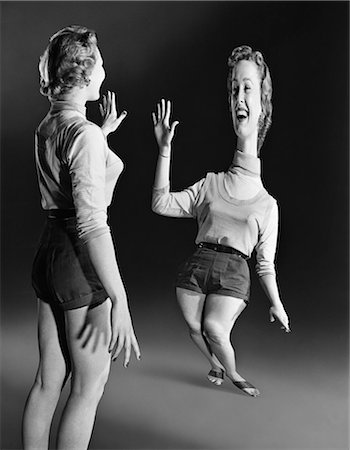
Figure 1: A crooked mirror distorts
proportions.
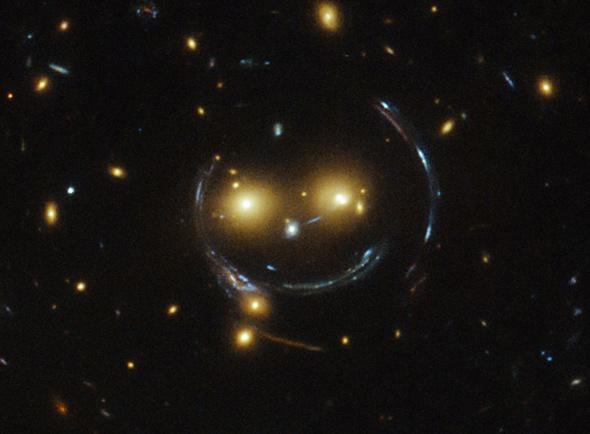
Figure 2: A gravitational lens imaged with
a telescope. The two central yellow lights in the image are actually
one.
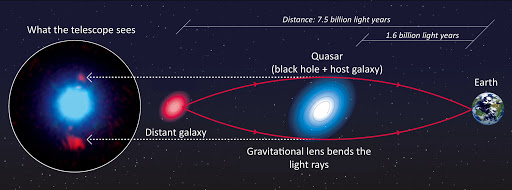
Figure 3: Gravity distorts the geometry of
space, causing light, which always travels in a straight line, to
change direction. Photons are massless and do not feel gravity, but
when the geometry of space bends, photons follow. This phenomenon is
called gravitational lensing.
Einstein's spacetime – three-dimensional space and time together, the
space in which we live – is a four-dimensional world in which the speed
of light is always, for everyone and everywhere constant. To make this
possible, distances shorten, masses increase and time slows down
locally, i.e. space 'stretches and bends' just like a mirror image in a
funhouse mirror. The theory of relativity is divided into special and
general relativity. Let's first get acquainted with the special theory
of relativity with illustrative examples. The special theory of
relativity does not require the speed of light in a vacuum to be
exactly 299792000 m/s, which is the real, measured speed of light, but
it can be any positive number, so for convenience we will agree that
the speed of light is c=100 m/s. To introduce the theory of relativity,
I will present an extreme, in reality impossible version of two car
drivers. Let us also agree that there is no gravity in the world, in
which case space-time will be called Minkowski space, meaning that we
will limit ourselves to the special theory of relativity for the time
being (we could indeed allow the existence of gravity in this example,
because we would reach the same conclusions anyway, but then space-time
cannot be called Minkowski space). Let us agree that the speed of the
car is 0.5c, or half the speed of light, in this example 50 m/s. We
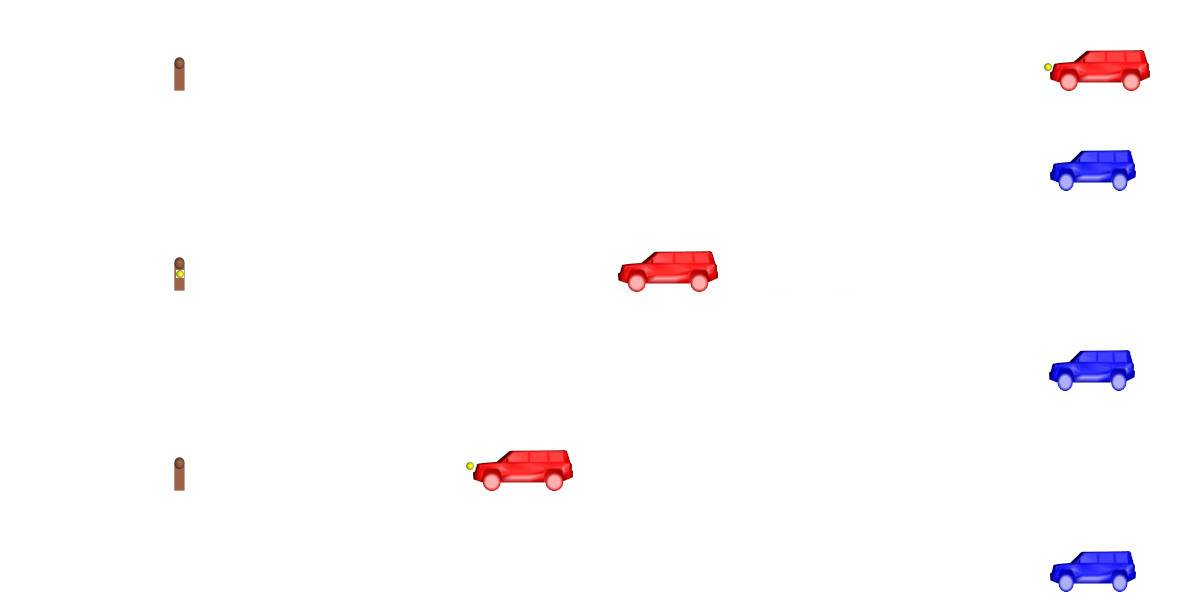
have two cars that are otherwise completely identical, but one is red
and the other is blue. Let us visualize the situation so that the red
car in Figures 4, 5 and 6 is moving at a speed of 0.5c, or half the
speed of light, and the blue car is stationary. In Figure 4, the red
car is either overtaking the blue car at a speed of 0.5c, or both cars
could equally well be stationary side by side on a two-lane road. The
driver of the red car flashes his headlights very quickly, for about 3
nanoseconds, the resulting burst of light is depicted by the yellow
ball. If the red car is stationary, the driver immediately accelerates
the car to a speed of 0.5c at the same time as flashing his headlights.
A kilometer away from the place where the red car flashed its
headlights, there is a kilometer post, from which the burst of light is
reflected back towards the cars.
Figure 4: A red and blue car are side by
side and the red car flashes its headlights and immediately starts
driving at a speed of 0.5c if it is stationary.
The burst of light reaches the kilometer post in Figure 5, and when the
speed of light is agreed to be 100 m/s,
Figure 5: The red car is halfway to the
kilometer post when the burst of light reaches the kilometer post.
According to formula 1, this happens after 10 seconds, after which the
burst of light is reflected back towards the cars. The burst of light
therefore reaches the stationary blue car after 20 seconds. This result
will probably seem completely reasonable to the reader and even correct
if the driver of the blue car is asked about it. The driver of the blue
car also agrees with us that the kilometer post is 1000 meters away
from him and that the light moved away from him at a speed of 100 m/s.
Figure 6: The red car is 333 meters from
the milepost when the reflected burst of light reaches it.
But what does the driver of the red car think about this? Before we ask
him anything, we could make the observation that the red car looks
shorter in both Figure 4 and Figure 5: from this we know that the red
car has been moving the whole time – including when the headlights were
flashing – (which is a good thing, since I am not talking about
acceleration of the car. The acceleration is gravitation and
gravitation does not belong to Minkowski space), because according to
the theory of relativity, a moving object shortens in the direction of
motion. We also know that, due to the theory of relativity, the driver
of the red car agrees with us at least that the burst of light moved
away from the driver of the red car at a speed of 100 m/s, despite the
fact that the driver himself was moving at a speed of 50 m/s at the
same time. Let's take formula 2 from the formulas
of the theory of relativity
and calculate how much the red car has shortened if its
length at rest is 5 meters:
The reader and the driver of the blue car believe that the red car has
shortened from 5 meters to 4.33 meters, but the driver of the red car
strongly denies this: on the contrary, he claims that the blue car has
shortened to 4.33 meters and that in the same proportion the kilometer
post is only 866 meters away in the situation in Figure 4! To determine
the moment in time when the driver of the red car believes that they
are in the situation in Figure 5, another formula from the theory of
relativity is applied
and the resulting time 8.66 s after the headlights are turned on, the
burst of light reaches the kilometer post. Now the speed of light is
the same for everyone:
In a situation where the burst of light has moved to the level of the
kilometer post (picture 6 and the middle situation in picture 7), the
driver of the red car thought that
he was 433 meters from the kilometer post. The arrival of the light
burst reflected from the kilometer post back to the eyes of the driver
of the red car (Figure 6 and the lowest situation in Figure 7) occurs
according to the driver of the red car
289 meters from the kilometer post, but according to the driver of the
blue car and the reader of this text, the distance was 333 meters from
the kilometer post:
Both the drivers of the blue and red cars are right (according to the
generally accepted relativity interpretation, but later in this text we
learn that the driver of the red car is lying about what he sees):
because of relativity, they simply perceive the world differently.
Whereas in Figures 4, 5 and 6 the world was viewed as seen by the
driver of the blue car and the reader, we could move into the red car
and then the situations in Figures 4, 5 and 6 would look like Figure 7:
Figure 7: the situations in pictures 4-6
according to the view of the driver of the red car, but he is not
telling the truth...
Hey, common sense, where are you?
Based on what has been written above, the theory of relativity probably
makes no sense to the reader: the course of events is completely
strange compared to everyday life. How can the same object be in
different places and at different times at the same time, as in the
previous example, cars, a burst of light and a kilometer post were? The
scientific community does not know how such a cosmic farce is possible,
but nevertheless the theory of relativity works in everyone's everyday
life all the time. The fact that the things described above are not
observed in everyday life is due to the fact that the speeds of objects
in the space in which we live are so small compared to the speed of
light. Even the speeds of celestial bodies do not reach anywhere near
the speeds at which relativity phenomena become observable. However,
this does not eliminate the fact that the relativity behavior of space
in the way described above is still very strange and contradictory.
I will now turn to speak about (elementary) particles instead of objects like
cars, since all objects are made up of particles. Many of the known
elementary particles are very short-lived, so the reader should assume
that the word 'particle' in this text refers to protons, neutrons, and
electrons, which are the particles that make up atoms and which are
particles with mass. I will also talk about a massless elementary
particle called a photon, which represents electromagnetic radiation.
According to the theory of special relativity, every moving particle
with mass in space has an infinite number of different positions,
depending on which other particle its position is measured in relation
to. But what if the massive particle is absolutely stationary? Asking
such a question is considered blasphemous by physicists, because
Einstein's theory of relativity assumes that absolute position does not
exist or at least cannot be determined: only relative position, i.e.
position relative to something else, can be determined. But in order to
find an explanation for how the theory of relativity is possible, we
have to invent something new and question the old. The theory of
relativity itself does not deny the existence of absolute position, it
is merely an assumption. What if the red moving car mentioned above
happened to be absolutely stationary in space, then what? There's no
way to know that (actually, you can in theory, but we'll get to that
later) and it doesn't have to have any observable effect on space or on
the theory of relativity.
The theory of relativity means that the 'same' time and place are not
the same for two observers moving at different speeds. I will now give
my own explanation of the theory of relativity's relative time and
relative position, and this explanation removes the contradiction
between the drivers of the blue and red cars so that Figure 7 and the
observations of the driver of the red car do not correspond to reality,
but Figures 4-6 and the observations of the driver of the blue car do –
or vice versa, depending on which of the cars is absolutely stationary
in space. I will deal separately with the contradictions caused by
relative time and relative position, since each has
its own,
independent solution. This text assumes that the blue car is absolutely
stationary in space (of course, in reality, no car is absolutely
stationary in space, even if it is parked, because the Earth is in
constant motion! But it is worth noting that all objects in space move
at cosmic speeds – well below 1,000,000 m/s, or 1,000 km/s – and
relativity phenomena are not relevant in such slow motion. Furthermore,
when objects move approximately the same speed and in approximately the
same direction, they see each other in exactly the same way and their
time progresses at the same speed, even if their absolute speeds are
significant from the perspective of relativity).
Relative and Absolute Time
I would like to start by warning the reader that I am now presenting
impossible paradoxes related to Einstein's theory of relativity. I
would also like to point out that the problems can be solved in a
simple way, which I will also present.
The fact that an event starts simultaneously from the same starting
point – which is observed both in from stationary and moving
observation point – and ends in terms of stationary position, for
example, after 10 seconds, but in terms of motion, the duration of the
same event is, for example, 8.66 seconds, requires an extension of the
time dimension from the present to the past: the matter associated with
the event, for example, the red car in the previous example, must have
a time dimension of at least 1.34 seconds. The matter of space consists
of massive elementary particles and an individual particle must exist
in the same state and position both after 8.66 seconds and after 10
seconds. And more, regardless of that, even if the particle, for
example, moves or changes into another particle. And if a particle has
been born at some point and later, for example, changes into another
particle or otherwise ceases to exist, the particle must have a certain
lifetime for an infinte number of different time frames, and therefore
its
time dimension must also be defined somehow.
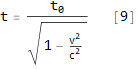
According to the formulas
of the theory of relativity
, the passage of
time for a massive particle of formula 9 does not slow down if the
particle remains stationary. In this case, the particle's time passes
maximally quickly. On the other hand, if the particle moves at a speed
slower than the speed of light, the passage of time for the particle is
maximally slower. And if a massive particle moves at the speed of
light, its passage of time stops completely. The time dimension s of a
particle is therefore the difference between the absolute time t0
and
the particle's own time t, which is defined for an infinitesimal
distance by the Lorentz world metric, or formula 8:
The two limit values thus obtained, t0 - t = s,
delimit the particle's dimension s on the time axis, if we substitute
its absolute velocity into formula 9 as the particle's velocity: when a
massive particle is born into spacetime, its time dimension comprises
only
the moment of birth, but after that the time dimension progresses along
the time axis at the front end with the absolute present moment,
advancing at maximum speed, and at the same time stretching at its rear
end in the pace of the slower relative passage of time to encompass a
longer period of time, so that for a long-lived and high-velocity
particle the time dimension may be millennia long or even longer after
billions of years. The moment of birth is the particle's present
moment, after that the present moment is the particle's rear end. The
above-mentioned absolute present
moment does not actually represent any kind of present, because
it cannot be defined from space-time, meaning we cannot measure it, but
it is necessary in a way we will see soon.
In contrast, with massless particles such as photons, which travel at
the speed of light, the time dimension only encompasses the absolute
present. The present of a photon progresses with absolute time, i.e.
time passes at the fastest possible rate; the difference is radical
compared to massive particles, whose own time does not progress at all
if they travel at the speed of light! However, it is worth noting that
a massive particle cannot be accelerated to the speed of light, because
according to the theory of relativity, this would require an infinite
amount of energy.
All this raises new questions: If the time dimension of a massive
particle is, say, ten years (the particle could be part of a spacecraft
that traveled almost the speed of light in space on a circumnavigation,
so that when it returned, the ship's clock was five years behind the
clock on its home planet. The particle already had another five years
before the space trip), and the particle absorbs a photon at the front
of its time dimension, then how can the particle's present moment, or
the back end of the time dimension, know anything about this? It can't
know it until the information about the absorption has moved from the
middle to the back end, which takes five years! And what happens when
the particle emits a photon? This is a more complicated situation: the
information about the emission first moves from the particle's present
moment, or the back end, to the absolute present moment, which takes
its time, and only then does the photon escape into spacetime.
The previous one might have raised more questions. If the transfer of a
photon from the lamp to the viewer's eye requires, say, eight years of
time travel into the future in the particle emitting the photon, then a
transfer from the lamp to the viewer's eye, and finally a five-year
time travel into the past in the viewer's eye, are all those years
added to the photon's travel time? If photons travel in the future, how
can we even perceive them, and when our relative present reaches the
future, isn't the present already defined by the photons in the future?
At this point, the reader is probably throwing up his hands and saying
that this makes no sense, and I completely agree with him or her!
So let's discard the time dimensions of particles, because they are
just abstractions I invented to illustrate Einstein's theory of
relativity in a way that just doesn't make sense. Instead, let's solve
the problem by stating the same thing that Einstein himself stated in
his time: time for each massive
particle runs at its own pace. A bit like in the old days, when
clocks were mechanical wind-up clocks, each clock ran at its own pace!
But what Einstein didn't say, and what the scientific community hasn't
yet stated as I write this, is that in order for time to run at its own
pace for each particle individually, and for all these times to proceed
individually at the speeds required by Einstein's theory of relativity,
an external pacesetter is
needed to adjust the time flow of each particle to the right pace. The
external pacesetter must have its own concept of time and space
independent of the theory of relativity, and I call these absolute time and position.
Furthermore, the external pacesetter itself is a prisoner of the
passage of time, just as nothing in spacetime can return to the past
or
move 'ahead of time' into the future: everything has its own present,
and for the external pacesetter this is the absolute present moment. However,
this text will not discuss the external pacesetter any further, but you
can learn more about it here.
It is important to understand that all physics and chemistry occur in
terms of relative time. We
can only measure relative time, and all our observations of our
environment occur in terms of relative time. A quartz crystal vibrates
in terms of relative time. We age in terms of relative time. However, absolute time is not needed for
anything other than determining absolute position, and this
determination cannot be made from spacetime.
Relative and Absolute Position
In the car example above, the driver of the blue car claimed that the
red car had shortened in length, and the driver of the red car claimed
that the blue car had shortened. Shortening, or shortening in length,
means a change in position, either at the front, the back, or both. To
accomplish this would require spacetime to do one of the following:
The first option is that electromagnetic radiation, or photons,
is
invariant and matter must 'multiply' itself to give itself the correct
proportions separately to all points of view for all possible speeds.
Another option is that matter is invariant and electromagnetic
radiation, or photons, know what is expected of them at any given time,
and they change their course accordingly so that at all points of
observation, an image obtained is distorted in just the right way.
This text does not, of course, support either of the previous options,
but it is clear that the same matter cannot appear in two or more
different places at the same time! So I assume that every particle in
spacetime has an absolute position:
then it is possible that the driver of the red car did not see the blue
car shortened, but was himself shortened – I can solve this problem
this elegantly, because humanity has never had a spacecraft or any
other device that would move at relativistic speeds, so that the
passengers could tell what the environment looks like at relativistic
speeds. Only the driver of the blue car saw the red car shortened
according to pictures 4-6, because the red car was absolutely
shortened! Therefore, I can declare the content of picture 7 to be
untrue. If absolute position is true, it is possible to know which of
the two bodies is moving at the greater speed within the absolute time
described above, and then it is possible that only the faster moving
body shortens more in its direction of motion than the slower moving
one (of course, all moving bodies shorten in their direction of motion
according to their speeds).
If absolute position did not exist, there would also be no absolute
velocity, and a particle could not be absolutely still, and then it
would be impossible to limit the time dimension of a massive particle
to the absolute present moment.
The letter combination CPT comes from the English
words Charge, Parity and Time. They represent three symmetry rules,
C-symmetry, P-symmetry and T-symmetry. In C-symmetry, particles and
antiparticles follow the same laws of nature, in P-symmetry, the laws
of nature do not change in a mirror image situation and in T-symmetry,
the system returns to its previous states. CPT symmetry means that all
of the above symmetries are combined into one.
In that case, it would not be possible to develop a theory of how
'matter in different times' interact with each other, i.e. how
relativity works. Thus, relative position does not actually exist
anywhere other than in a person's own observations of their environment
and, of course, in Einstein's theory of relativity. Absolute position
may never be measured by a person, although I believe it exists. On the
other hand, absolute stationarity can be measured if the necessary
technology could be built. But unlike relative time, defining relative
position as absolute changes the behavior of observable reality to
something different from what Einstein himself thought in Einstein's
theory of relativity. Relativity was developed to implement CPT
symmetry, and therefore in the car example above, both drivers of the
car were supposed to see the other car as shortened in the direction of
motion. But the idea of absolute position – and thus one car
shortening more and the other shortening less or not at all – breaks
CPT symmetry, and that's fine. We saw from Figures 4-6 and 7 that they
contradict each other and the only way to remove that contradiction is
to abandon CPT symmetry. CPT symmetry is a human-developed construct of
thought, not an observation. Humanity has never driven a car or any
other device at relativistic speed, so humanity does not know what kind
of world the driver of the red car would see. But what did the driver
of the red car possibly see? We could think that he would see the blue
car stretched out, because he himself had shrunk, but since the
kilometer post must be 866 meters away anyway, the image cannot be
formed. The driver of the red car was probably unable to see anything
that was not traveling with his eyes in approximately the same
direction and at the same speed: that is, he saw nothing but noise, the
snowfall of old CRT televisions.
Instead, it is known indirectly from the results of particle
accelerator experiments that the driver of the blue car sees the red
car as shortened in the direction of its motion. Of course, this is
assuming that the blue car is absolutely stationary, or moving at a
cosmic speed of at most, say at most 1000 km/s, which compared to the
relativistic speed of at least 45000 km/s is as if it were stationary.
It is important to note that although absolute and relative time
actually exist according to this text, relative position does not
exist: particles only have an absolute position, which we cannot
determine.
I have now made two changes to Einstein's theory of relativity, namely
adding absolute time and absolute position. But it should be noted that
these changes do not affect the mathematics of special relativity in
any way - the original equations of Einstein's special relativity are
valid and work exactly as Einstein originally intended them. Similarly,
the above formulas 1-9 are all still valid. And even though relative
position does not exist, we still do all calculations with relative
time and position values, because we have nothing else available;
provided that the basic coordinate system, which is perceived as
'stationary' in the calculations, is actually moving at a cosmological
speed in space, relative time and position values give 'sufficiently
correct' results.
General Relativity
Everything written above was related to the special theory of
relativity, which only deals with time and position. But there is a
third element in relativity that must be taken into account: mass. In
this case, we are talking about the general theory of relativity.
According to the general theory of relativity, the mass of an object
increases as the speed of the object increases, time slows down as the
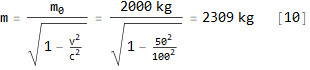
speed increases, and length shortens as the speed increases. For
example, in the car example above, if the rest mass of the red car is
2000 kilograms, its mass at a speed of c/2 would be
2309 kilograms. A clear increase in mass, but not so great that it
would have any bearing on the conclusions drawn in the text above. I
wrote earlier that it would be possible to determine whether an object
in space is absolutely stationary. This is achieved by moving the
measuring object freely in three dimensions on a very precise scale
that is stationary (it does not have to be absolutely stationary). When
the direction and speed at which the mass of the measuring object is
smallest is found, the absolutely stationary position has been found.
Naturally, the accuracy of the scale must be so high that it is
unlikely that such a thing can ever be built, let alone a device that
can controlably move the measuring object at the necessary cosmic
speeds.
General relativity and the inclusion of mass change the situation in
relation to special relativity in such a way that the geometry of space
is no longer unchanging, but is in a constant state of change all the
time: mass in space causes spacetime to bend. Thus, even massless
particles, such as photons of electromagnetic radiation, change their
direction under the influence of gravity by traveling along the
straightest path, the geode, as exemplified by the gravitational lens
in Figure 2.
But general relativity changes the concept of a straight line even in
completely empty, massless space: it requires that spacetime is a
curved, closed spherical surface. Let's get to know general relativity
through Einstein's equation:
Equation 11 contains the general theory of relativity in its entirety.
In the equation, Gab is the Einstein tensor, Tab
is the
energy-momentum tensor, c is the speed of light, 8π is the solid angle
in spacetime, and f is the gravitational constant, which has a value of
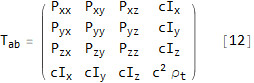
6.67259*10-11 Nm2/kg2. The energy-momentum tensor Tab is a
4x4 matrix that describes the properties of matter in spacetime in
terms of the energy density ρ, the momentum density I, and the
(surface) pressure P:
The reader might ask that since the general theory of relativity is
intended to include gravitation in relativity, wouldn't it be important
to find out how mass is distributed in space? That is precisely the
purpose of the energy-momentum tensor 12. But, since calculation 10
showed us that the magnitude of mass depends on the speed at which mass
moves in space, we cannot use mass or density as a criterion for the
distribution of matter in space. We need some quantity whose amount
remains constant in space and which specifically describes the
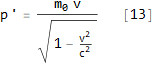
occurrence of matter: Einstein defined momentum as such, i.e. the
product of mass and velocity. Unfortunately, the matter is not quite
that simple, because the speed of light as a speed maximum limits the
use of classical momentum, i.e. the product of mass and velocity, so
the momentum p must be redefined for the theory of relativity according
to formula 13:
The energy-impulse tensor 12 is usually used to determine the strength
properties of an inhomogeneous material, for example rock, soil or a
wooden object. In this case, the tensor would be just a 3x3 matrix,
since the time dimension is not needed in the case of a static body and
it would be called the stress tensor. But the tensor 12 is part of
Einstein's equation and is intended to describe the matter in all of
space, i.e. celestial bodies and space dust, solar systems and
galaxies, which I assume are distributed more or less evenly,
homogeneously and isotropically throughout spacetime, so the tensor
needs information about the impulse and energy density in addition to
pressure. This text will not explain how to obtain the necessary values
for the tensor 12. How else can there be pressure in space at all,
when it is mostly empty space? Well, there is no true pressure, and the
symbols Pab of the tensor 12 do not represent pressure, but
the flow of
momentum. Then why am I talking about pressure at all? Because Einstein
originally applied the theory of classical continuum mechanics to his
general theory of relativity, and the idea of "pressure" is rooted in
that.
Instead, the Einstein tensor Gab on the left side of
equation 11 is more interesting than the one on the right, because it
determines, among other things, the geometry of space. But what exactly
does equation 11 solve if the left tensor determines the geometry of
space and the right tensor determines the distribution of matter in
space? Naturally, we would like to find out the gravitational field of
space so that we could calculate, for example, the exact trajectory of
the planet Mercury (the Newtonian mechanics of classical physics can
calculate the orbit of Mercury almost correctly, but the calculated
perihelion precession deviates slightly from the observed value. This
small deviation is explained by the general theory of relativity). This
requires two things: the geometry of space, which in the case of
Mercury's trajectory means the gravitational field of the Sun, and the
distribution of matter in space, which includes the masses of Mercury
and other necessary celestial bodies – at least the largest planets
orbiting the Sun. Determining an arbitrary gravitational field, i.e.
the general solution of equation (11), is not possible, and in practice
we have to settle for quite simple arrangements. Let us write equation
11 in such a form that there is also a separate tensor for the
gravitational field in the equation:
In equation 14 gab is the so-called metric tensor, which
determines the geometry of spacetime. The term Λgab also
needs a metric tensor, but it is not part of the Einstein tensor.
Therefore, only a term dependent on the metric tensor gab
can be added to equation 11, as is done in equation 14, without
affecting the law of conservation of energy. The other variables in
equation 14 are the Ricci tensor Rab and the Ricci scalar R,
as well as the cosmological constant Λ, which Einstein added to the
equation to make space stable, i.e. so that space would neither grow
nor shrink. The gravitation of matter affects the geometry of space by
curving it, as can be seen from the gravitational lens in figure 2, but
this effect is not yet included in the metric tensor gab,
but the Ricci tensor is needed for it. The Ricci tensor determines the
curvature of space, as will be explained in more detail here.
Within the framework of relativity, it is therefore not possible to use
mass as a measure of the amount of matter, because mass changes with
velocity. This does not mean, of course, that matter, i.e. electrons,
protons or neutrons, is lost or created: the mass of the particles in
question only depends on their velocity. Therefore, matter must be
measured by other methods, and the rate of flow of momentum through
each point in spacetime is suitable for this purpose.
Metrics of General Relativity
Let us now turn our attention to the cosmological constant Λ. As
mentioned, Einstein added a term containing the cosmological constant Λ
to equation (14) to make space stable, but since then that term has
mostly been removed from the equation. When the Big Bang theory of the
universe was invented, space did not need to be stable, but expanding
space is a natural consequence of the Big Bang and the cosmological
constant was allowed to go.
Furthermore, as the Friedmann Robertson Walker models became
established to describe spacetime, the metric of general relativity was
changed from the metric originally proposed by Einstein. Einstein's
metric is given in equation 15,
but the Friedmann Robertson Walker metric chosen instead of the
Einstein metric is represented by formula 16:
This text follows formula 15, the metric originally presented by
Einstein. This collection of texts also disputes the existence of the
Big Bang. However, it is good to illustrate the difference in the
metrics of formulas 15 and 16 in practice: namely they describe
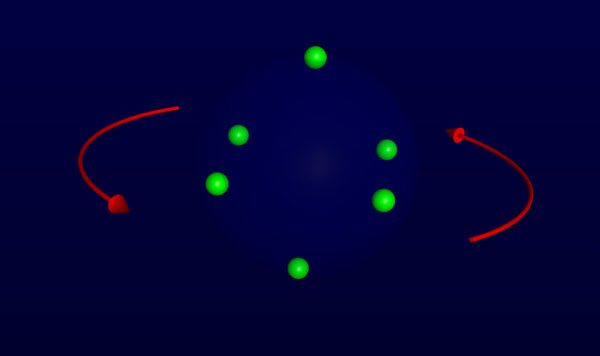
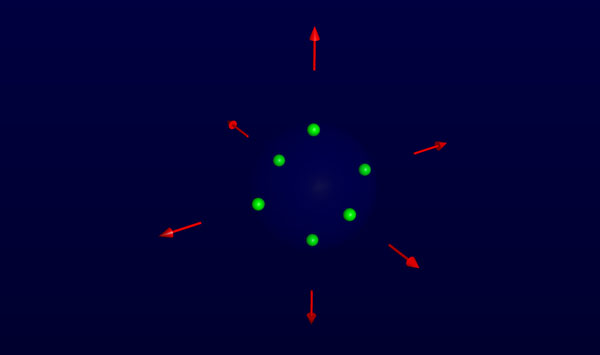
completely different worlds. Figure 8 shows the spacetime according to
formula 15 and figure 9 shows the spacetime according to formula 16:
Figure 8: In Einstein's original metric,
the three spatial dimensions and one time dimension of space are placed
on the four-dimensional surface of a five-dimensional blue sphere. In
the figure, the green spheres represent celestial bodies and other
matter on the surface of the sphere, i.e. in space. The spheres rotate
counterclockwise in the direction indicated by the red arrows, because
that direction is depicted as the direction of time in the figure.
Figure 9: In the Friedmann Robertson
Walker metric, the three spatial dimensions of space are placed on the
three-dimensional surface of a blue four-dimensional sphere. The time
dimension is parallel to the radius of the sphere, and therefore the
green spheres representing celestial bodies and other matter move away
from each other in the direction indicated by the arrows, away from the
Big Bang at the center of the sphere. Thus, the theory of relativity
can be used as a 'proof' for the theory of the expansion of the
universe, but it is only a matter of choosing a metric.
Figure 9 clearly shows that the Friedmann Robertson Walker metric
actually requires an expanding space for time to flow. In contrast,
Einstein's original metric in Figure 8 does not require space to expand
or contract, but it does, unless the cosmological constant Λ is used to
correct the problem. But what exactly does the term Λgab represent in
equation 14? Its unit must be the same as the other terms in the
equation, energy density. If Ʌ is negative, it tends to shrink space.
When Ʌ is positive, it causes space to expand. In other words, when
negative, the cosmological constant reduces the gravitational field of
space, and when positive, it strengthens it evenly throughout
spacetime. It is also possible that the cosmological constant Ʌ is not
a constant, but a variable quantity, although Einstein thought it was a
constant.
Summary
The above text on Einstein's theory of relativity aims to present the
theory of relativity as Einstein intended it, with the exception of the
following clarifications:
Relativity does not mean that there is no absolute position or
time in space.
Lorentz contraction is not symmetrical: only the faster moving
object A shortens absolutely in the direction of motion, the slower
moving object B shortens less or even a stationary B does not change
its absolute dimensions.
The material has absolute rest mass.
The Friedmann Robertson Walker metric or something similar does
not belong to the theory of relativity, but the metric must be the
metric originally proposed by Einstein.
CPT symmetry does not exist.
Space is not expanding but stable and can potentially be adjusted to
the desired size using the cosmological variable Λ. Who would make this
adjustment can be read about here.
These refinements are necessary to
make a 7-dimensional universe model possible.